At Harvard’s Ingersoll Lecture, Elizabeth Strout reflected on the ordinary people, imperfect characters and unanswered questions that shape her fiction.
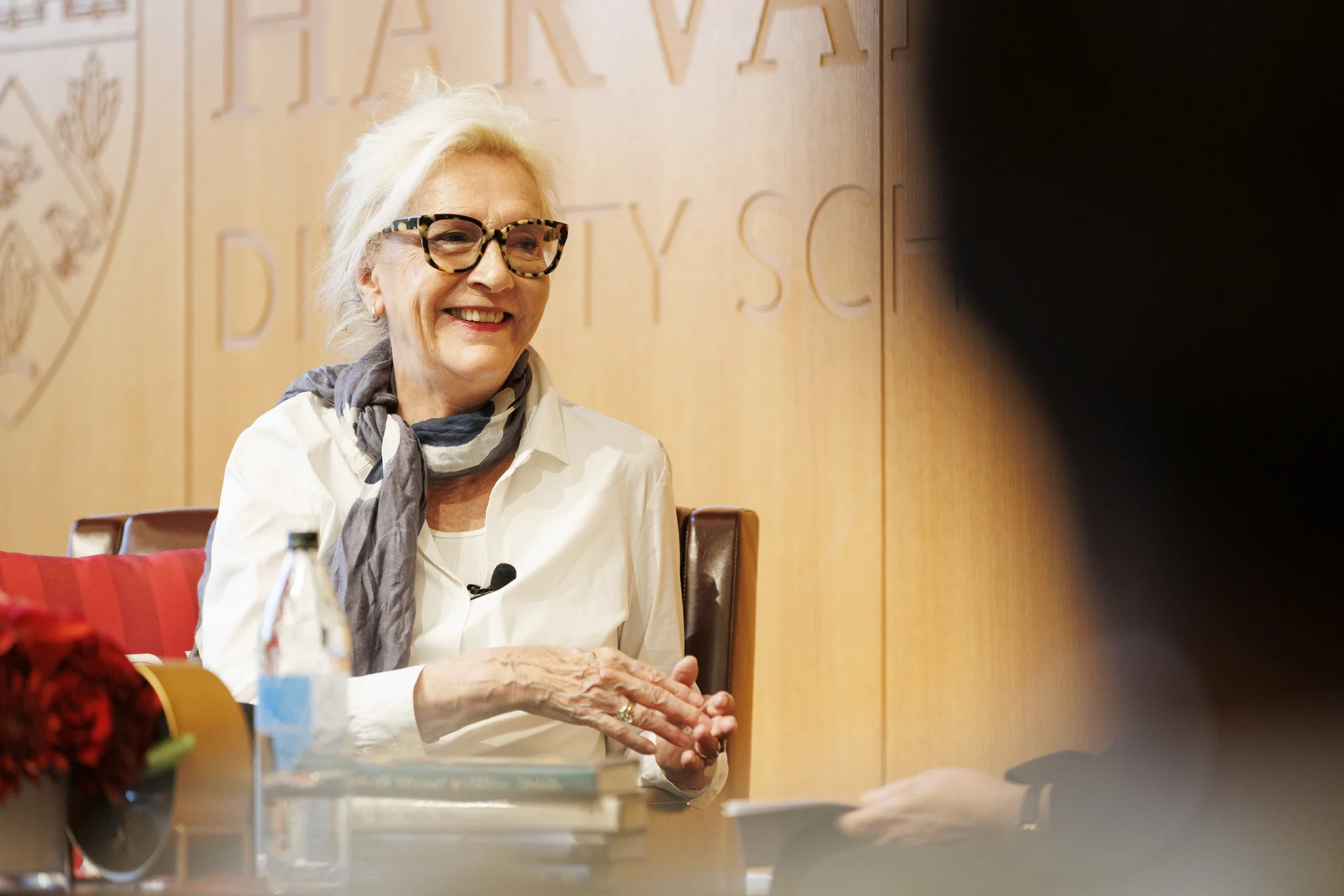
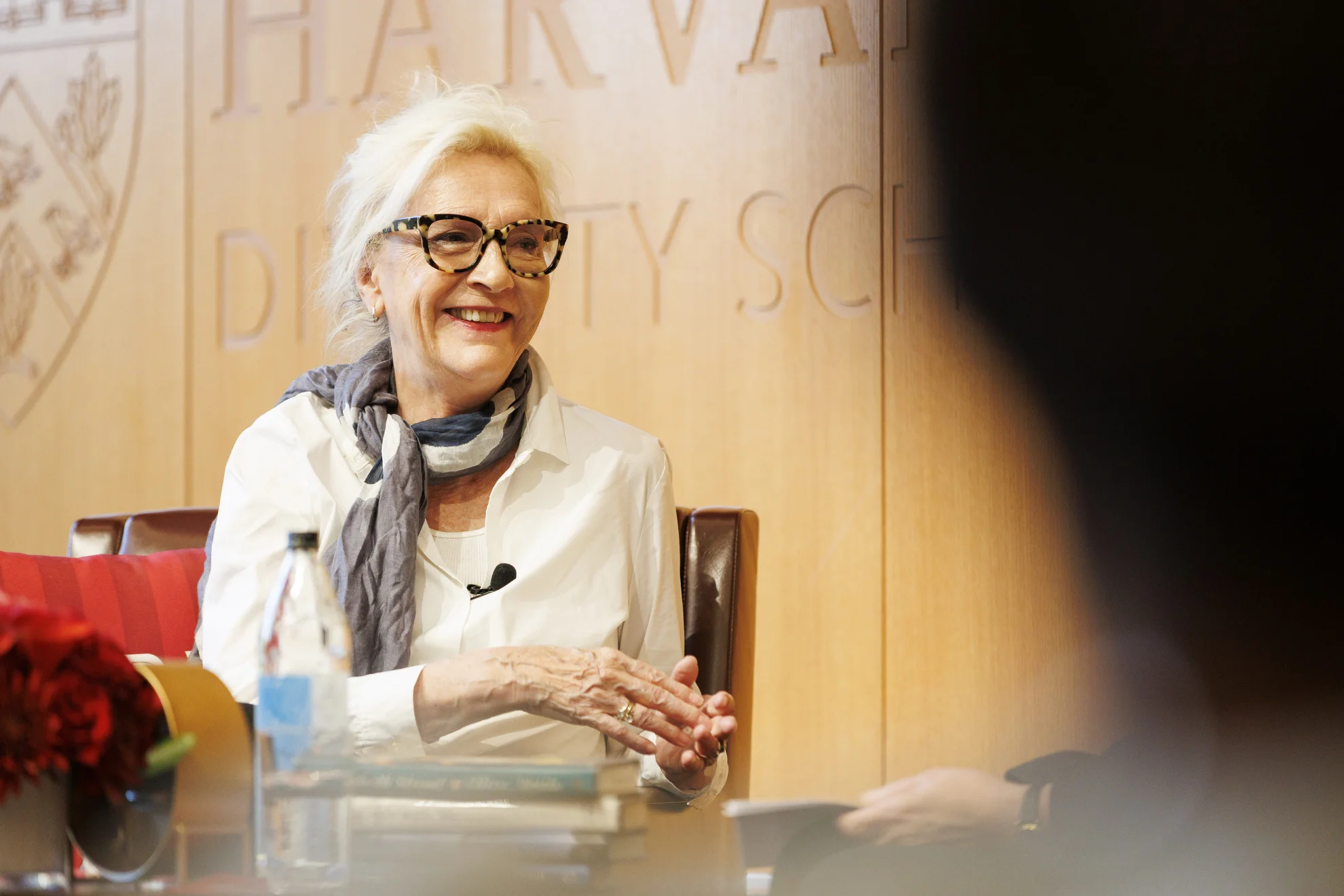
Niles Singer/Harvard Staff Photographer
Elizabeth Strout, mystery writer
Pulitzer-winning novelist brings a keen sense of the unknown to Divinity School
Elizabeth Strout’s fiction returns to a question she has carried since childhood: how much can we ever know about another person? At Harvard Divinity School’s Ingersoll Lecture, the Pulitzer Prize-winning novelist described that uncertainty as a starting point for her stories—and a defining condition of being human.
Growing up in rural New England, Strout spent time alone in the woods, but people drew her attention. A trip to town offered glimpses of lives she could only imagine. “Whenever we went to town, I loved seeing people,” she said. “I wanted to know about their lives. And I realized, when I was young, that I was never going to know. So I had to make it up.”
That impulse has carried through 11 novels, many set in Maine, where Strout was born. Her books include “Olive Kitteridge,” which won the 2009 Pulitzer Prize for Fiction, as well as “The Burgess Boys,” “My Name Is Lucy Barton,” and “Lucy by the Sea.” Her interconnected stories follow ordinary people whose decency coexists with mistakes, loneliness and family tensions.
In conversation with Catherine Brekus, the Charles Warren Professor of the History of Religion in America, Strout discussed how those characters arrive on the page and why she keeps returning to the limits of self-knowledge. Some figures come to her nearly complete, she said, with their own voices and oddities. Their settings—fictional towns in Maine and coastal Massachusetts—also draw on a lifelong attachment to the natural world.
“The beauty of the physical world was my first friend,” Strout said. As a child in the woods, she recalled, she felt a “sense of transcendence.” The landscape, in her account, is more than scenery: it connects the stories to the solitude and wonder that shaped her early imagination.
Writing began early, with encouragement from her mother, a schoolteacher. Strout was four when she started, around the same time she developed a love of reading and watching people. Without a television at home, she read Harper Lee, J.D. Salinger and Ernest Hemingway. “Writing has always been a vocation,” she said. “I have known that from a very young age.”
The vocation took years to become a career. Strout received repeated rejections in her 20s and 30s, earning money through night jobs that included cocktail waitressing and playing piano while she wrote by day. Unsure she could make it as a novelist, she went to law school, then left after six months working as a lawyer.
For years, she kept her writing private. “Nobody wanted to know — and I didn’t want to tell them,” she said. “I was scared that I would fail.” She remembers imagining that still working as a cocktail waitress at 58 would be “depressing.” She was 43 when her first book, “Amy and Isabelle,” brought critical acclaim and public attention.
Her latest novel, “The Things We Never Say,” is shortlisted for the 2026 Booker Prize, with the winner scheduled to be announced Nov. 9. Strout was also nominated for the PEN/Faulkner Award in 2000 and 2009.
The moral complexity of her characters is central to her approach. Strout said she isn’t drawn to writing purely evil people; remorse, she argued, matters because people have to reckon with the harm they cause. “We’re all flawed,” she said. “Part of what makes us human is to feel bad about something horrible we did.”
That attention to contradiction fits her view that people remain partly unknowable, even to themselves. “We don’t really know who we are,” she said. “We think we know, but we don’t. And we don’t know each other as well as we think we do.”
Strout’s answer isn’t to solve that mystery. It’s to live with it. Quoting one of her characters, she described a duty “to bear the burden of the mystery with as much grace as we can.” The Ingersoll Lectures began at Harvard in 1896 and have been organized and hosted by the Divinity School since 1979.


Discussion
Sign in to join the discussion.