Hudlin’s collection spans 1949–2025 and offers researchers a window into comics, publishing and changing cultural attitudes.
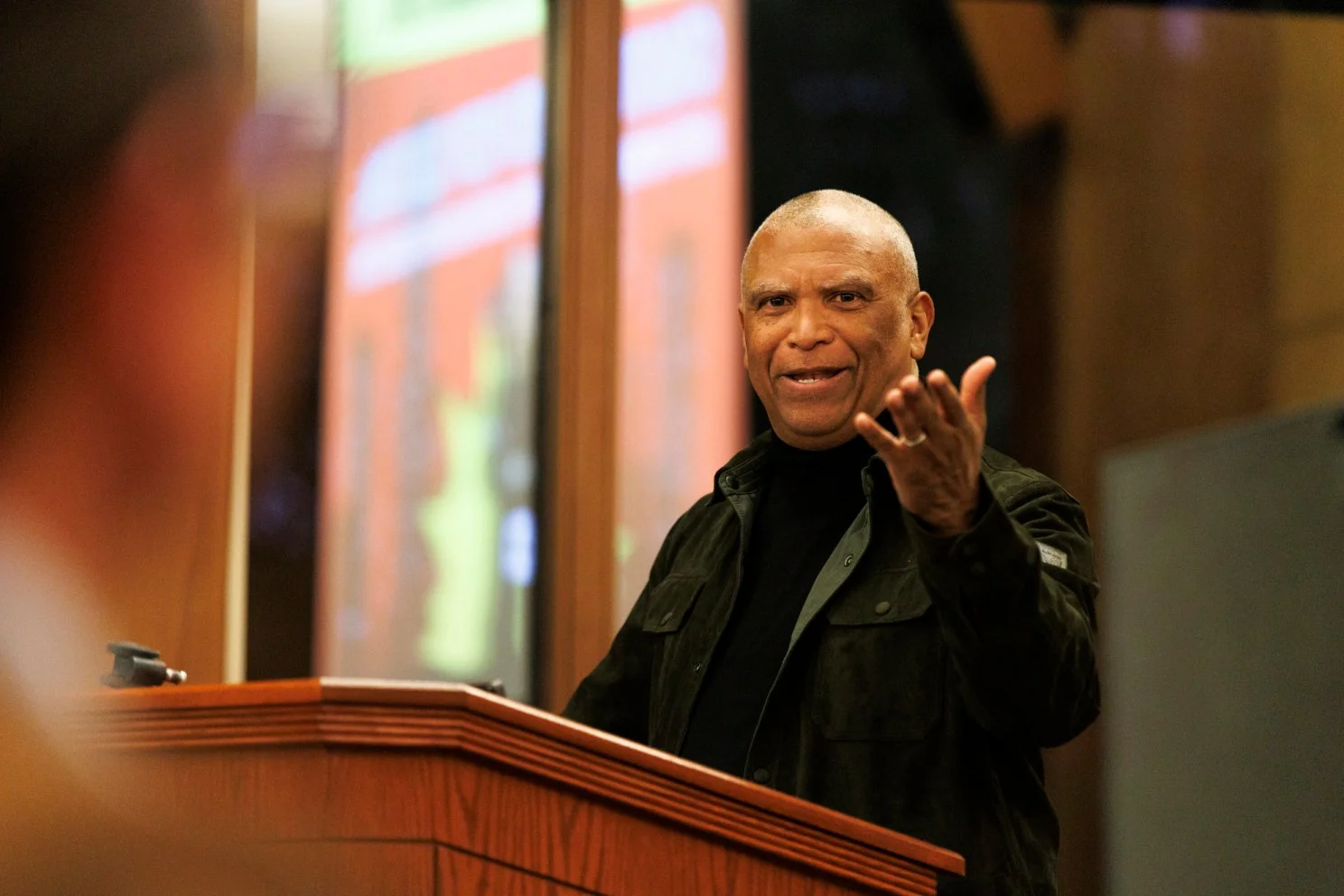
Nearly 25,000 comics collected by filmmaker and producer Reginald Hudlin ’83 are headed to Harvard’s Houghton Library, where they’ll be available to scholars, students and the public. The gift gives researchers a broad view of American comics across seven decades, from major superhero franchises to titles from smaller publishers. Its size matters, but so does the range: a library collection can put familiar characters and less widely read publications into the same research setting, where their differences and connections become easier to examine.
Hudlin discussed the collection and his career during an Oct. 22 talk at Lamont Library. His account of four decades in Hollywood came back to a simple principle: follow the work that holds your interest, even when a safer choice looks more practical. That advice comes from someone whose projects have moved across several forms, but it wasn’t presented as a guarantee of success. It was a description of how he’s chosen what to make.
“I like making a movie, then making a TV show, then doing a documentary, then putting on a concert, then writing a comic book, because I just want to create,” he said. The list is a compact explanation of the range that defines his career. It also helps explain why a comics collection is part of his legacy: for Hudlin, the medium sits alongside film, television and live events as a form of creative work.
A collection built across generations of comics
The Reginald Hudlin Collection of Comics contains issues published from 1949 to 2025. It includes work from Marvel and DC, alongside titles from Atlas, Charlton and Vertigo. Familiar characters represented in the collection include the Avengers, Batman, Black Panther, Green Lantern, Iron Man, Spider-Man and Wonder Woman. The span offers researchers material from multiple eras of American comics, while the mix of publishers gives them a way to study how different companies approached the form.
For Leslie Morris, Houghton’s Gore Vidal Curator of Modern Books and Manuscripts, the collection’s value reaches beyond the stories themselves. She said it can help document how comics reflect changing views of race, gender, class and sexuality, while supporting research into art, design and publishing history. That perspective treats comics as both creative works and cultural objects: their images and narratives can be read alongside the decisions involved in making and publishing them.
That breadth fits Hudlin’s own career, which has moved among film, television, documentaries, live events and comics. He came to Harvard as a Visual and Environmental Studies concentrator, hoping to become a filmmaker at a time when few Black directors worked in Hollywood. His route from student films to a career across media gives the collection a personal connection to the institution, but its research value won’t depend on readers knowing his biography. The material can be approached through the questions it raises about the medium itself.
“I’m just going to do what I care deeply about. That’s what makes me happy,” he said. There’s a practical point in that statement: a career built across formats can reflect sustained curiosity as much as a fixed plan. And yet, moving between fields also means working with different audiences and production demands. Hudlin’s remarks frame that variety as a choice he’s continued to make.
From Harvard shorts to Black Panther
As a Harvard junior, Hudlin wrote and directed three short films. One grew into “House Party,” his 1990 feature debut, starring hip-hop duo Kid N’ Play. The comedy was added to the Library of Congress National Film Registry in 2022. The path from a student short to a feature shows how an early project can develop into work with a much wider audience, though that outcome shouldn’t be mistaken for a predictable career formula.
His later credits include Quentin Tarantino’s “Django Unchained” (2012), as well as broadcasts of the Academy Awards and Emmys. Hudlin also brought his comics fandom into his screen work: Marvel published the first issue of his “Who Is Black Panther” series in 2005. The run lasted three years and later helped shape the 2018 blockbuster film. The sequence links his work in comics with a major screen adaptation, while underscoring that stories can change as they move between formats.
That movement is part of what makes comics useful to study alongside film and television. A comic’s pages combine writing, drawing and design in a form that readers encounter differently from a broadcast or feature film. Researchers can ask how characters and ideas are presented on the page, and how those choices sit within the period and publishing context in which the work appeared. The collection’s variety gives those questions room to extend beyond a single franchise.
Creative choices, and what the collection makes possible
Hudlin described Hollywood as an uncertain business, even for someone with decades of experience. At times, he’s weighed a conventional career move against a project that felt more personal. “Occasionally, you go, ‘You know, this passion thing is hard. Can I just do the smart move and win?’ But for me, it doesn’t work.” His answer is candid, but it shouldn’t be read as a universal prescription. Creative work depends on circumstances, and his point was about the choices that have made sense for him.
Here’s the thing: a large collection’s significance comes from what people can do with it over time. The comics can support research into popular stories, but also into the publishing choices, visual styles and cultural assumptions that shape those stories. This is more significant than it looks. When material from major and smaller publishers is available together, scholars can compare work across companies and generations rather than treating the best-known characters as the whole history of the medium.
If you’re working in this space, the collection offers a reason to look at comics as evidence of both artistic practice and changing social ideas. (And this is the part most people overlook.) A library’s role isn’t only to preserve objects; it’s also to make them available for questions that haven’t yet been asked. A lasting resource for future study.
Hudlin’s collection now gives that creative range a home at Houghton, with material for future study of both popular culture and the industries that produce it. Its usefulness will depend on what researchers choose to examine, from individual characters to the broader history of how comics are made and read. The gift puts those questions within reach of the public as well as scholars and students.


Discussion
Sign in to join the discussion.