The Euler characteristic distinguishes a sphere from a torus, showing why a beach ball can’t become one ring through cutting and gluing.
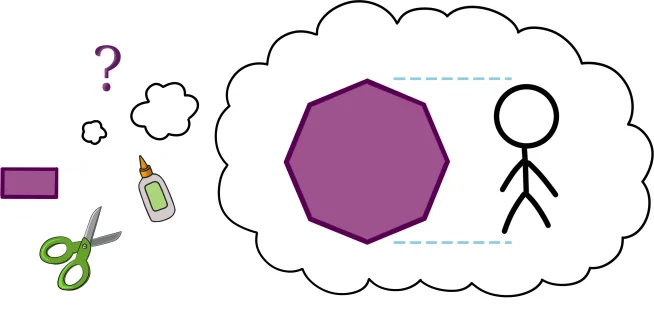
The obstacle to turning a beach ball into a rubber ring isn’t its size or the amount of material. It’s topology: under the rules of cutting and rejoining a surface, the two shapes carry different values of a mathematical invariant called the Euler characteristic. That difference rules out the transformation, even when stretching is allowed.
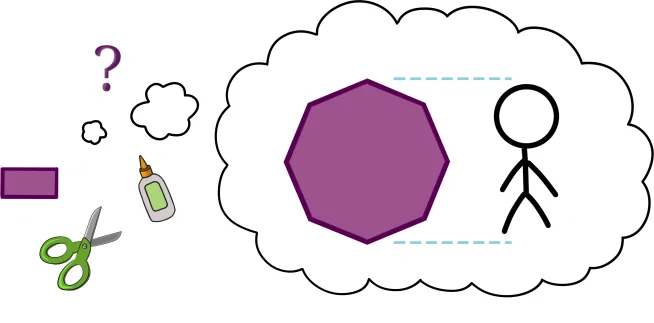
The result becomes clearer by starting with a simpler question about pieces of cardboard. If you cut a polygon into smaller polygonal pieces and reassemble them edge to edge, you can change its shape, but not its area. Area is an invariant: a property that stays the same under the allowed operations. If two polygons have different areas, cutting and gluing cannot make them equivalent.
From area to volume
For polygons, area turns out to be more than a useful test. In the early 19th century, William Wallace, Farkas Bolyai and Paul Gerwien proved that any two polygons with equal area can be made from each other by cutting and rearranging finitely many pieces. Their construction can turn a polygon \(P\) into a rectangle with side lengths 1 and \(\operatorname{area}(P)\): first divide the polygon into triangles, then rearrange each triangle into a rectangle, reshape those rectangles, and join them. Every step can be reversed, so equal area fully characterizes polygonal cut-and-paste equivalence.
That neat answer doesn’t survive the move into three dimensions. Volume remains invariant when a solid is cut into pieces and reassembled, but equal volume alone doesn’t guarantee that two solids can be matched this way. David Hilbert included the question among the 23 problems he posed in 1900. A year later, his student Max Dehn found an additional invariant, now called the Dehn invariant. A cube and a regular tetrahedron can have the same volume yet different Dehn invariants, so they can’t be rearranged into one another through cutting and rejoining.
In 1965, Sydler showed that volume and the Dehn invariant together are the only cut-and-paste invariants for three-dimensional solids. Jessen extended the result to four dimensions in the 1970s. For higher dimensions, whether those same two quantities provide a complete answer remains open.
What counts as a surface?
A beach ball and a rubber ring are surfaces: the ball is a sphere, while the ring is a torus. A disc is another example, with a boundary curve around its edge. In this setting, surfaces may have boundaries, but they can’t have corners. Cutting and rejoining must also preserve the surface structure: pieces can’t be discarded, and the cuts and joins must avoid creating malformed junctions such as T-shapes.
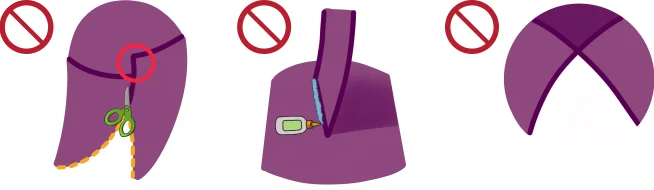
Creating corners, gluing into a T-shape and overlapping pieces are all illegal at this beach
To study a surface, mathematicians can approximate it with triangles, a process called triangulation. The triangles may be curved, and there are many possible triangulations of the same surface: any triangle can be subdivided into smaller ones to create another. The technique also has practical uses, including building computer models of objects such as vases and human organs, and representing shapes in video games.

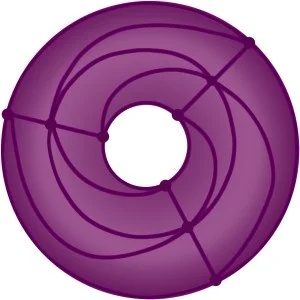
Once a surface is triangulated, we can count its vertices, edges and faces. The counts vary with the chosen triangulation, but a particular combination does not: vertices minus edges plus faces. This number is the Euler characteristic, written \(\chi\).
A sphere and a torus have different values
Consider two triangulations of a sphere. One has 17 vertices, 45 edges and 30 triangles; another has 5 vertices, 9 edges and 6 triangles. In both cases, the calculation gives 2: \(17-45+30=2\), and \(5-9+6=2\). The count stays constant even as the triangulation changes, so the Euler characteristic belongs to the surface itself.
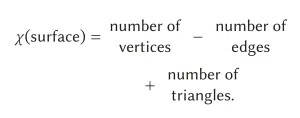
A triangulation of a torus with 12 vertices, 36 edges and 24 triangles gives a different result: \(12-36+24=0\). Thus, \(\chi(\text{sphere})=2\), while \(\chi(\text{torus})=0\). Euler’s name is attached to this quantity because Leonhard Euler proved that the Platonic solids—tetrahedron, cube, octahedron, dodecahedron and icosahedron—each have Euler characteristic 2. They are polyhedral versions of a sphere.
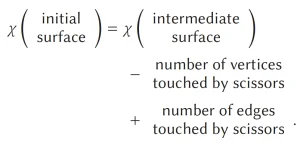
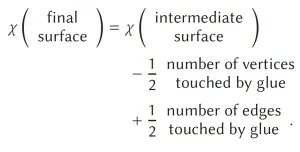
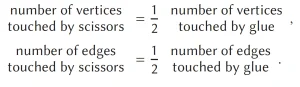
The key question is whether cutting and gluing can alter \(\chi\). A triangulation can be chosen so that cuts follow edges. When a cut duplicates an edge or vertex, the resulting pieces gain matching counts of each: a duplicated vertex adds one to the vertex total, while a duplicated edge adds one to the edge total. Since the Euler characteristic subtracts edges from vertices, those changes cancel. The triangles themselves aren’t duplicated by the cut.
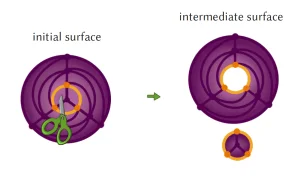
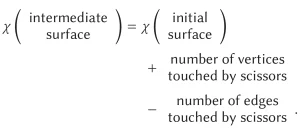
For example, cutting a disc from one hemisphere of a sphere creates an annulus and a disc. Three vertices and three edges along the cut are counted on both sides. The change to vertices minus edges is therefore \(+3-3=0\), leaving the combined Euler characteristic unchanged.
The same accounting applies when two discs are cut from the sphere, one on each hemisphere. Six vertices and six edges are duplicated, so the total still balances.
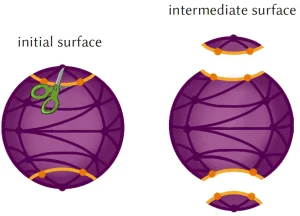
Rejoining pieces reverses the bookkeeping. Vertices and edges along the glued boundaries merge, and each contributes equally to the counts being compared. Because every cut must be repaired, the gluing accounts for the duplicated vertices and edges introduced earlier. The net effect is zero: the Euler characteristic survives the full cut-and-paste process, including when the intermediate pieces form a disconnected surface.
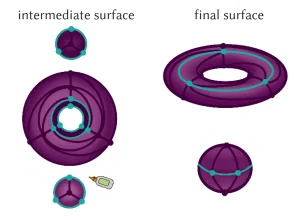
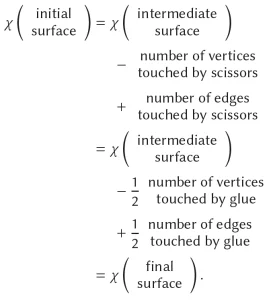
That settles the beach-ball puzzle. A sphere’s Euler characteristic is 2, and a torus’s is 0, so a sphere cannot be cut and reassembled into a single torus under these rules. Yet a useful transformation is possible: cut the sphere and rejoin the pieces as a sphere plus a ring. The child gets an inflatable ring, and the original ball remains represented in the result.
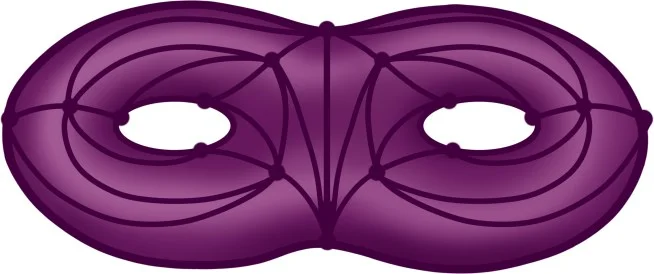
A triangulation of the double ring
When the invariant matches
Now add a double ring to the sphere and ask whether both can be reassembled as one ring. A triangulation of the double ring has 22 vertices, 72 edges and 48 triangles, giving \(\chi=22-72+48=-2\). Combining it with the sphere adds 2, for a total of 0—the same Euler characteristic as a single torus. The invariant allows the transformation, but matching values alone don’t show the construction.
In the 1970s, Ulrich Karras, Matthias Kreck, Walter Neumann and Erich Ossa proved that the Euler characteristic is the only cut-and-paste invariant for surfaces. The same result holds for higher-dimensional generalizations of surfaces. So the matching value isn’t just a lack of evidence against the transformation: no other invariant of this kind rules it out. A sphere and a double ring can be cut and rejoined into a single ring. Working out the cuts is the remaining challenge.



Discussion
Sign in to join the discussion.