Quantum Machines' integration of NVIDIA's NVQLink enhances quantum programming speed and accessibility, enabling real-time execution across multiple processors.
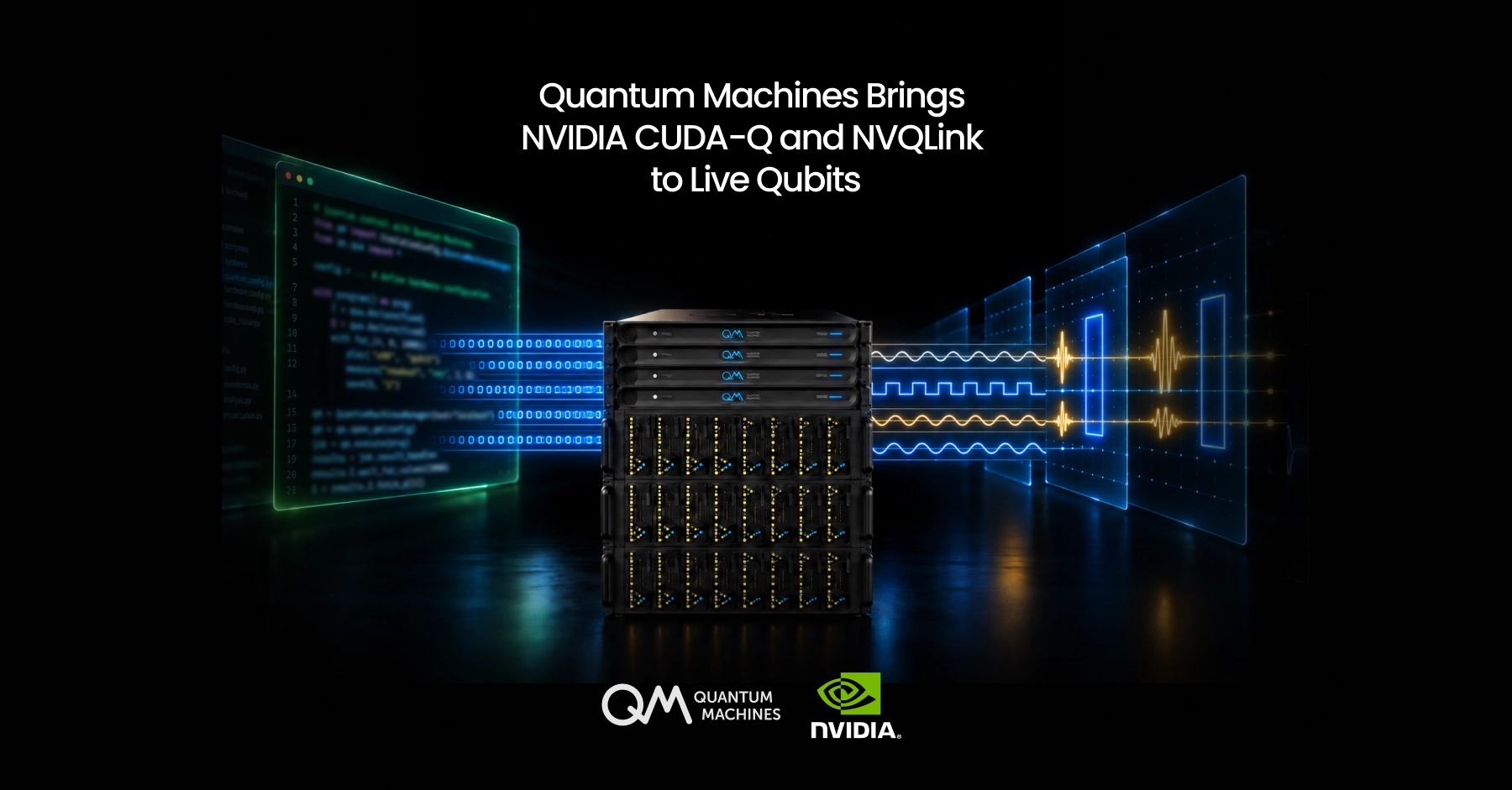
In September 2026, Quantum Machines achieved a significant milestone by successfully executing an end-to-end NVIDIA CUDA-Q program across live qubits, leveraging their Pulse Processing Unit alongside NVIDIA’s NVQLink. This demonstration establishes a fully integrated quantum-classical workflow, completing data exchanges in about one millionth of a second—a critical timeframe for real-time applications.
One of the standout benefits of this advance is its simplification of quantum programming. Developers can now work with familiar programming languages such as Python and C++, diminishing the traditionally steep learning curve associated with specialized quantum control languages. “We have been collaborating closely with NVIDIA for quite some time, and it’s exciting to see our technologies converge,” stated Yonatan Cohen, the CTO of Quantum Machines. This partnership aims to accelerate the development of large-scale quantum computers.
Unifying Quantum and Classical Processing with CUDA-Q
The integration of Quantum Machines' control stack with NVIDIA's CUDA-Q is a significant advancement in executing a single program across both quantum processing units (QPUs) and classical processors like GPUs and CPUs. Utilizing NVQLink’s microsecond connection, this approach allows developers to route tasks efficiently to the right computing resource, thus reducing the time from prototyping to deployment across both research and commercial platforms.
As NVIDIA indicated, this trend aligns with the industry’s move toward unified computing frameworks, similar to how GPUs evolved from specialized accelerators to essential components in modern computing systems. Sam Stanwyck, Director of Quantum Product at NVIDIA, articulated this vision, asserting, “Quantum processors become transformative when working tightly alongside GPUs and CPUs as a single unified quantum supercomputing system.” This integration simplifies the connection between qubit controllers and NVIDIA's framework, ensuring measurement data can swiftly inform control systems—a critical necessity for tasks requiring immediate decision-making like quantum error correction.
Another significant aspect of this collaboration is its real-time capacity. Developers can write applications in languages like Python, C++, or QUA, while Quantum Machines’ control systems translate these high-level commands into precisely timed instructions vital for manipulating qubits. This real-time conversion ensures compatibility with various quantum and classical hardware, enhancing the practicality of quantum applications.
We have been working closely with NVIDIA for a long time and are very happy to see these technologies and tools come together to enable quantum developers and allow them to move faster towards realizing large-scale quantum computers.
Yonatan Cohen, CTO of Quantum Machines
NVIDIA's NVQLink Brings Microsecond Data Exchange
NVQLink plays a pivotal role by facilitating rapid data transfer between quantum controllers and GPUs, significantly improving the efficiency of hybrid applications. This advancement minimizes the technical barrier that often accompanied quantum programming by reducing reliance on deep expertise in quantum hardware. The combination of Quantum Machines’ CUDA Quantum platform and NVIDIA's DGX Quantum systems supports robust hybrid workflows. Collaborations with firms like Quantinuum and QuEra Computing further demonstrate the ecosystem's expanding potential.
NVIDIA's strategic investment in QuEra in 2025, highlighted by July 2026's announcement of a calibration model functioning across six different qubit types, signals ongoing efforts to enhance overall system interoperability. The swift data exchange enabled by NVQLink is positioning quantum computing closer to practical, scalable applications.
Dynamic Integration for Real-Time Quantum Control
The architecture leveraged by Quantum Machines allows developers to treat QPUs as easily accessible resources within their applications, moving away from isolated experiments to integrated systems that promote efficiency. With CUDA-Q, the system transforms developer operations into precise signal sequences for qubit control, easing the burden of hand-coding and making quantum programming more accessible.
Through partnerships with entities such as QuEra Computing, Rigetti, and IonQ, NVIDIA is committed to forging a unified ecosystem that supports the functionality of CUDA-Q and NVQLink. This strategic alliance is instrumental in streamlining quantum application development and fostering a vibrant quantum computing future.
Quantum processors become transformative when working tightly alongside GPUs and CPUs as a single unified quantum supercomputing system.
Sam Stanwyck, Director of Quantum Product at NVIDIA
See today’s quantum computing news on Quantum Zeitgeist for the latest breakthroughs in qubits, hardware, algorithms, and industry developments.



Discussion
Sign in to join the discussion.