Anyon Computing's new quantum control system integrates quantum processors with NVIDIA's infrastructure, enhancing performance and scalability.
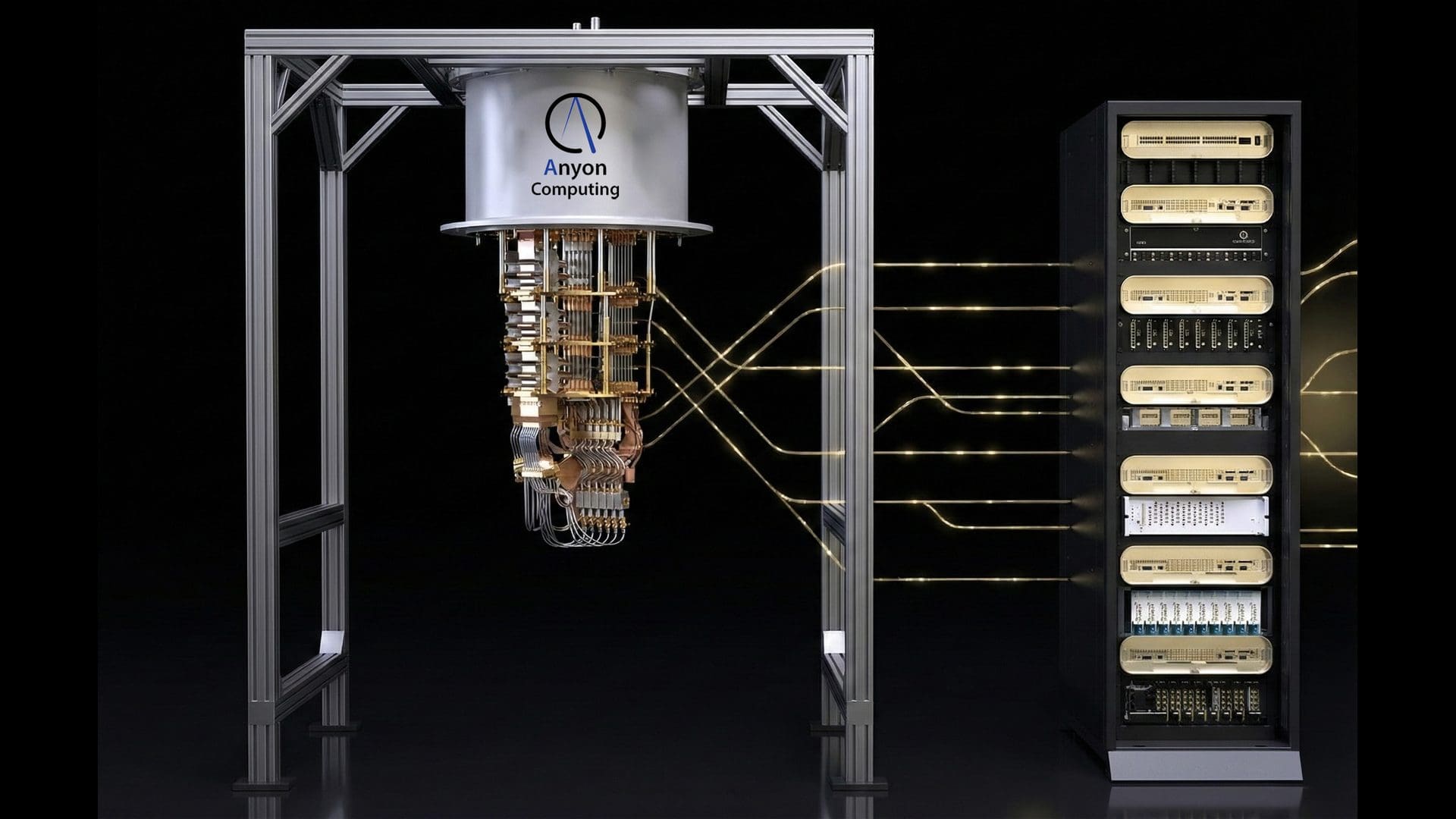
Anyon Computing has introduced a groundbreaking open quantum control system that incorporates quantum processors as co-processor nodes alongside GPUs and CPUs, a shift from the conventional "quantum box" structures. This system, leveraging NVIDIA's NVQLink technology, enables the rapid measurement of quantum-classical loops in microseconds, which is vital for sustaining qubit coherence during complex calculations that surpass the capabilities of a single chip.
“A quantum supercomputer has to be one machine, not a quantum box bolted onto a classical one,” asserts Roger Luo, Co-Founder and CEO of Anyon Computing. His comments highlight the core philosophy driving this design aimed at future data centers.
Anyon’s NVQLink Integration and Its Role in Co-Processing
This innovative quantum control system employs NVIDIA NVQLink to facilitate microsecond-level monitoring of quantum-classical loops, essential for maintaining qubit coherence. Unlike traditional configurations where quantum processors function as separate entities linked to classical hardware, Anyon's system is integrated as an intrinsic component of a unified machine. This approach tackles a significant barrier in scaling quantum technology: the necessity for quick feedback between quantum measurements and classical processing.
Calibration, control, and error correction demand substantial computational resources that cannot be contained within a single chip, thus requiring a tightly coupled setup where latency in data transfer is minimized. Anyon's implementation allows for the execution of CUDA-Q programs directly on the quantum processors, enabling adaptive quantum-classical loops to function at speeds ranging from milliseconds to microseconds without the delays tied to recompilation.
Communication between host nodes and peer controllers is streamlined using commodity RDMA-over-Ethernet links, which assists in scaling the control plane from an individual node to a larger, interconnected network. This development process involved autonomous AI agents, marking a significant departure from traditional methods in constructing complex quantum computing infrastructure.
According to Anyon, the integration of their system with NVIDIA’s infrastructure plays a critical role in advancing this technology. Sam Stanwyck, NVIDIA's Director of Quantum Products, emphasizes that “building useful quantum-GPU supercomputers is a heterogeneous systems challenge, as quantum processors need tightly coupled access to accelerated resources.” He further reiterates that Anyon's use of NVQLink paves the way for addressing essential workloads in large-scale quantum computing, like calibration, control, and error correction.
The design fosters scalability, with phase-locked controllers on a common reference, mimicking the expansion seen in traditional data centers. This structure suggests potential for more advanced quantum-classical hybrid systems in the future.
AI-Driven Approaches to Quantum Control Systems
This architecture represents a significant evolution in the interaction between quantum and classical resources, moving past the outdated model of treating quantum processors as peripheral hardware. The immense computational demands associated with calibration, control, and particularly error correction surpass what any single processor can handle. Through a novel approach, AI agents autonomously enhanced the system design from the initial register-transfer-level coding, progressing through simulation, construction, and hardware-in-the-loop verification, all with minimal human intervention.
This marks one of the preliminary instances where an advanced real-time FPGA system has achieved production release through such automated methodologies. “We built it the way we intend to build everything from now on, with AI agents doing the engineering against real hardware,” the company states.
NVIDIA's expansion of the NVQLink architecture in November 2025 in collaboration with Oxford Quantum Circuits and Orca Computing further solidifies its role as a key enabler within the hybrid quantum-classical computing space.
The newly launched CUDA-Q logical, designed with quantum error correction in mind, underscores Anyon’s ongoing commitment to developing fault-tolerant quantum architectures. The company plans to open-source their system, setting it up as a critical control framework for forthcoming quantum data centers while expediting the development of scalable, real-time quantum computing solutions.
“A quantum supercomputer has to be one machine, not a quantum box bolted onto a classical one. We built this control system using NVIDIA NVQLink so that our control cluster and the quantum processors it drives are co-processor nodes next to the GPUs and CPUs, on the same fabric and in the same program.”



Discussion
Sign in to join the discussion.