Cornell and MIT's research on quantum computational sensing improves magnetic field measurement accuracy by integrating computation into readings.
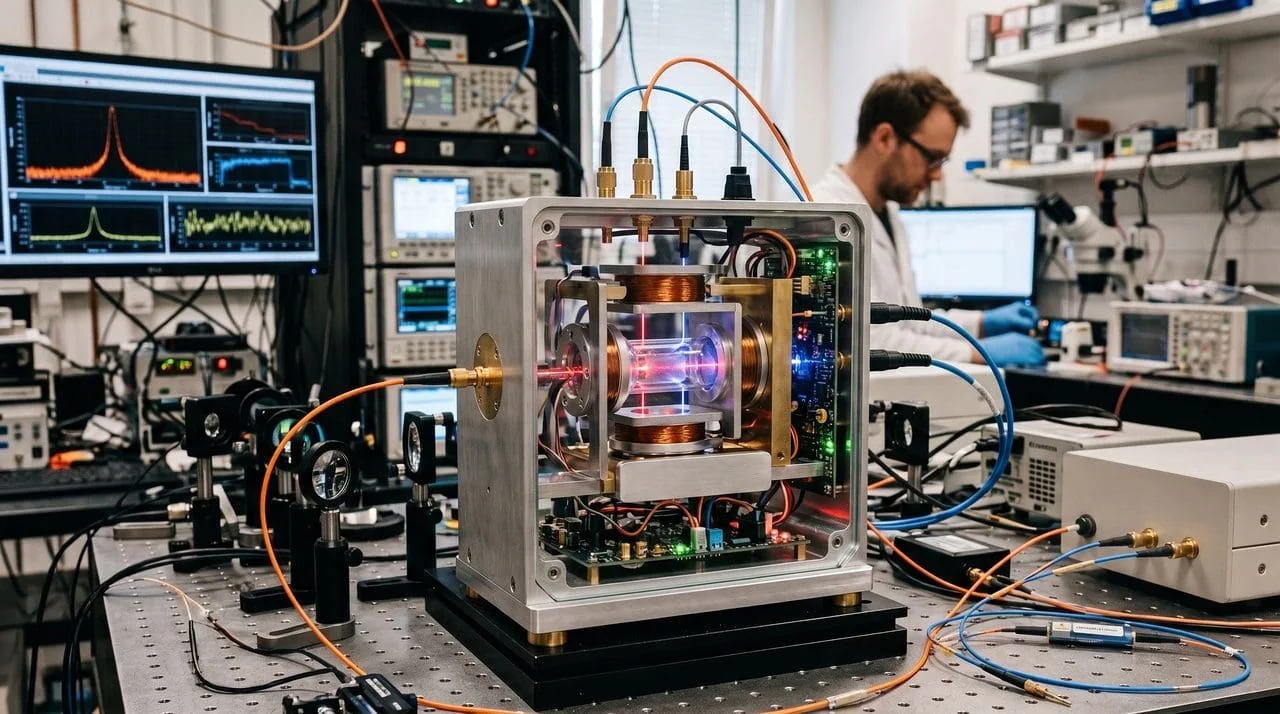
Recent advancements in quantum sensing have transformed how measurements are taken and analyzed, notably in magnetic field applications. A collaborative effort by researchers at Cornell University and the Massachusetts Institute of Technology (MIT) has resulted in a new methodology known as quantum computational sensing. This approach uniquely integrates computation into the measurement phase, significantly refining the accuracy of magnetic field classifications.
Traditionally, magnetic field sensing relied on a sequence of multiple measurements followed by classical computational analyses to produce reliable signal estimates. However, the new technique allows for relevant data to be captured in each individual measurement, which streamlines the entire data analysis process. In trials focused on static magnetic fields, their protocol demonstrated an impressive improvement—up to 15 percentage points over conventional methods.
Revolutionizing Measurement with Integrated Quantum Computing
The implications of this advancement are profound. By employing a superconducting qubit—analogous to embedding a calculator into a thermometer—the team achieved immediate processing capabilities that eliminate the need for extensive data averaging. Sensors are no longer bogged down by lengthy computations. This integration allows them to deliver accurate assessments in real-time, vastly reducing the amount of time and computational power required for data analysis. And this is the part most people overlook: the shift from raw data collection to immediate data processing could redefine how we interface with measurement technologies.
In practice, this new configuration enables far better classification of both static and oscillating magnetic fields. For instance, the new technique resulted in up to a 20 percentage point increase in accuracy when assessing oscillating magnetic field amplitudes, a significant improvement over prior methodologies, which often struggled with the nuances of signal variations. These precise measurements can have profound implications in fields ranging from medicine to materials science, where understanding even minute variations in magnetic fields can lead to more informed diagnoses or advancements in material properties.
Classifying Magnetic Fields with Greater Precision
The researchers demonstrated methods that enhanced the discrimination of frequencies by 17 percentage points compared to established protocols such as Ramsey-based phase estimation and dynamical-decoupling techniques. By concentrating key information in a single measurement, this breakthrough not only simplifies data interpretation but also opens various avenues for extending the applicability of quantum sensors. Historically, detailed frequency discrimination was only achievable through complex multi-step processes, often introducing errors and uncertainties.
Despite being in its early developmental stage, the use of a single transmon qubit has already shown remarkable performance. It's promising, but challenges persist in scaling this method for larger systems. Maintaining coherence while increasing complexity remains an area of active investigation. Quantum systems are notoriously difficult to manage as they scale, and preserving their unique advantages without succumbing to noise and environmental interference is no trivial task. If you're working in this space, knowing the hurdles could inform how you approach future technology integrations.
Next Steps in Quantum Computational Sensing
The research team is now focusing on techniques aimed at mitigating error accumulation when deploying multiple qubits in arrays. This error correction is critical as it can determine the real-world usability of these sensors in practical settings. Moreover, they are exploring various quantum algorithms that may further enhance the effectiveness of their sensing capabilities. This ongoing development hints at the possibility of a future where quantum sensors can not only measure but also analyze and interpret data autonomously, guiding decisions across various industries.
Future work is set to adapt this approach for different sensor types beyond just superconducting qubits and SQUIDs. This adaptability could lead to broader applications in quantum sensing, creating instruments that are not only more accurate but also more versatile. Quantum computational sensing could disrupt industries by offering new measurement standards, especially in sectors that require high levels of precision, such as aerospace, defense, and healthcare.
This innovative approach challenges the traditional model of quantum measurement, which often necessitates repeated readings and complex analytics. By embedding processing capabilities directly within the sensing device, researchers have taken a significant step toward making quantum sensors more efficient, particularly in resource-constrained scenarios where classical computational power may fall short. The integration of computation into sensing signifies a paradigm shift that could redefine how we view measurement technologies.
This advancement positions quantum computational sensing at the forefront of magnetic measurement technologies, allowing for the potential development of compact, low-power sensors suitable for a range of practical applications. With this direction, the field of quantum sensing could redefine standards for precision in various industries, particularly in areas requiring high fidelity measurements. The implications reach beyond just improved accuracy; they could enable entirely new applications we haven’t even considered yet.
Implications and Future Outlook
The impact of these developments may extend well beyond the laboratory. As quantum computational sensing matures, commercial applications could leap forward, leading to sensors that power advancements in areas like biomedical imaging, navigation systems, and environmental monitoring. This could help standardize measurement practices across different industries, helping sectors align on protocols and methodologies. More broadly, as these systems become more affordable and accessible, we might see quantum sensing integrated into consumer electronics, educational tools, and even smart home devices.
👉 More information
🗞Quantum sensors that compute: quantum computational magnetic-field sensing using a superconducting qubit
✍️Purnendu Sen, Mathieu Ouellet, Saeed A. Khan, Wayne Wang, Sridhar Prabhu, Alen Senanian, William P. Banner, William D. Oliver and Peter L. McMahon
🧠 ArXiv: https://arxiv.org/abs/2608.17400



Discussion
Sign in to join the discussion.