AMD's advanced hardware plays a pivotal role in enhancing qubit control and error correction within Quantum Machines' systems.
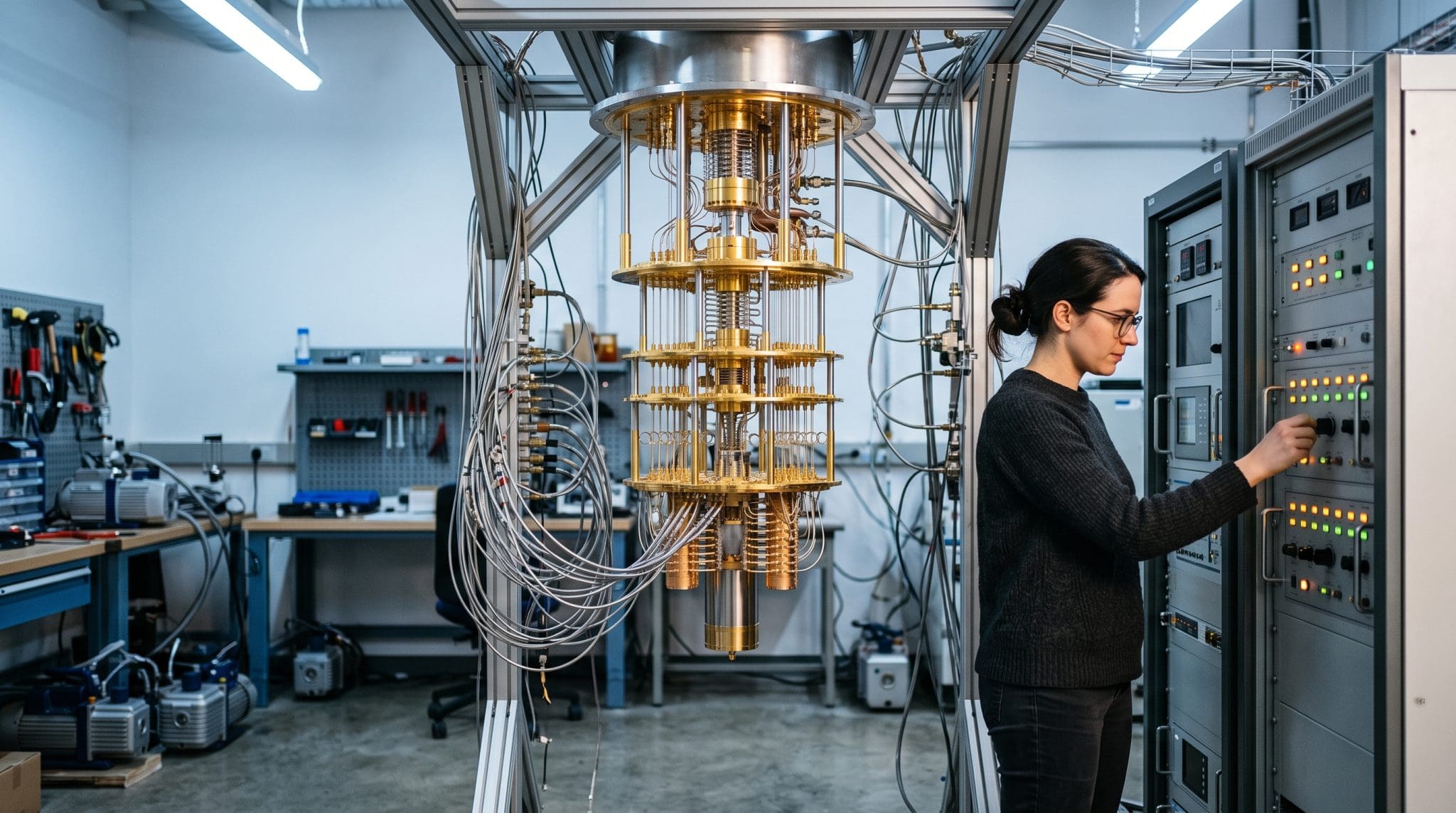
In the fast-evolving field of quantum computing, precision in controlling qubits is paramount. AMD has positioned itself as a key player by integrating its technologies into Quantum Machines' Hybrid Control architecture. This architecture is not just about the individual qubit; it encompasses an entire robust classical computing framework designed to manage and optimize these delicate quantum states.
Ethan Baratz, Senior Product Manager at Quantum Machines, emphasizes the critical nature of timing: "The control electronics must act on qubits with nanosecond precision before their quantum states decohere." This precise timing is essential for effective quantum computing, where AMD's hardware facilitates the merger of high-speed control with complex computational tasks. This structuring allows different workloads to be allocated to the most appropriate resources, enhancing the overall computation efficiency.
Advancements with AMD Versal Devices
Central to achieving the required nanosecond-level precision is the use of AMD Versal devices within Quantum Machines' control systems. These devices enable real-time pulse processing, crucial for maintaining deterministic timing as data flows between quantum and classical layers. This level of control is critical for preserving qubit coherence during operational cycles. AMD’s adaptive computing devices bring unparalleled speed to this process, supporting rapid feedback mechanisms necessary for the quantum runtime.
AMD EPYC processors complement the Versal devices by providing robust computing power capable of handling extensive classical processing tasks. This combination facilitates efficient data orchestration across the entire quantum stack. Ensuring that the quantum processor receives timely and accurate information is vital for maintaining stability and enhancing performance. The layered integration of these technologies supports everything from immediate pulse shaping to extensive quantum error correction, underscoring a partnership that delves deep beyond mere component supply.
Meeting the Demands of Fault-Tolerant Quantum Computing
As the quest for fault-tolerant quantum systems progresses, maintaining gate fidelity across trillions of operations becomes a formidable challenge. Continuous quantum error detection, decoding, and correction are fundamental elements of this task. AMD's recent findings suggest that its Alveo accelerators can significantly enhance quantum simulation performance by as much as 30 times, a capability crucial for efficient error mitigation.
Hybrid Control Architecture: Distributing Workloads Effectively
Taking cues from classical computing models, Quantum Machines has devised a hybrid control architecture that allocates computing tasks across specialized hardware. This strategic split allows for optimized performance, recognizing that not all quantum operations require the same computational resources. For instance, certain tasks are better processed within the controller, while others are ideally suited to high-performance servers or external accelerators. With execution timelines compressing into mere hundreds of nanoseconds, this orchestration becomes all the more essential.
AMD's enabling technology throughout the Hybrid Control architecture facilitates this demanding orchestration. As the number of qubits grows — potentially reaching tens of thousands — the importance of heterogeneous computing architectures increases exponentially. A spokesperson for Quantum Machines expressed excitement about these prospects, emphasizing the necessity for an orchestrated approach that not only improves qubit performance but also enhances the underlying classical infrastructure. This infrastructure's ability to accommodate a diverse range of workloads across varying timescales is central to future quantum computing advancements.
OPNIC: A New Era of Quantum Communication
The introduction of the OPNIC interconnect marks a significant advancement in quantum-classical computational synchronization. This PCIe-based optical interconnect provides a deterministic pathway for data transfer, overcoming conventional Ethernet's latency challenges. Such precision ensures that various external computational resources can synchronize perfectly with quantum operations, a problem that has historically posed difficulties in scaling quantum systems effectively.
By implementing the OPNIC technology, Quantum Machines can foster a cohesive system where different computational resources collaborate efficiently. AMD’s Versal devices facilitate the execution of larger-scale hybrid workflows, including extensive tasks like quantum error correction decoding while maintaining reliable communication links with the quantum controller. This architecture supports various workflows across a broad timescale, from hundreds of nanoseconds to milliseconds, essential for sustaining gate fidelity over a massive number of operations. As highlighted by a representative from Quantum Machines, aligning information processing with precise timing is vital for operational success.
The Challenge of Quantum Error Correction
Managing quantum error correction is particularly demanding; it requires distributing the computational workload among various classical hardware components. For instance, processing tasks such as image analytics for atom readout often extend into milliseconds, far surpassing the ultra-fast requirements of many critical operations. This necessitates a tiered architecture, wherein specialized resources handle specific tasks, improving the overall efficiency of the system.
Quantum Machines' integration of AMD technologies across its Hybrid Control architecture exemplifies a shift away from merely supplying components to fostering collaborative solutions. This holistic approach allows computationally intensive tasks to be offloaded to external systems, including high-performance servers and specialized accelerators. AMD EPYC processors further enhance this framework by providing the critical server-side architecture needed for complex classical computations, thus allowing for a smooth division of labor in today's multifaceted quantum computing environment.
As every cycle of error correction generates substantial information, the computational demands are significant. AMD’s collaboration with Quantum Machines recognizes the essential nature of this partnership in the quest for scalable quantum computers. The challenge lies not just in enhancing qubit technology but also in refining the classical architecture that governs them.



Discussion
Sign in to join the discussion.