Quantum Source Labs has introduced a novel technique utilizing single-atom memory to significantly improve entanglement rates for scalable quantum systems.
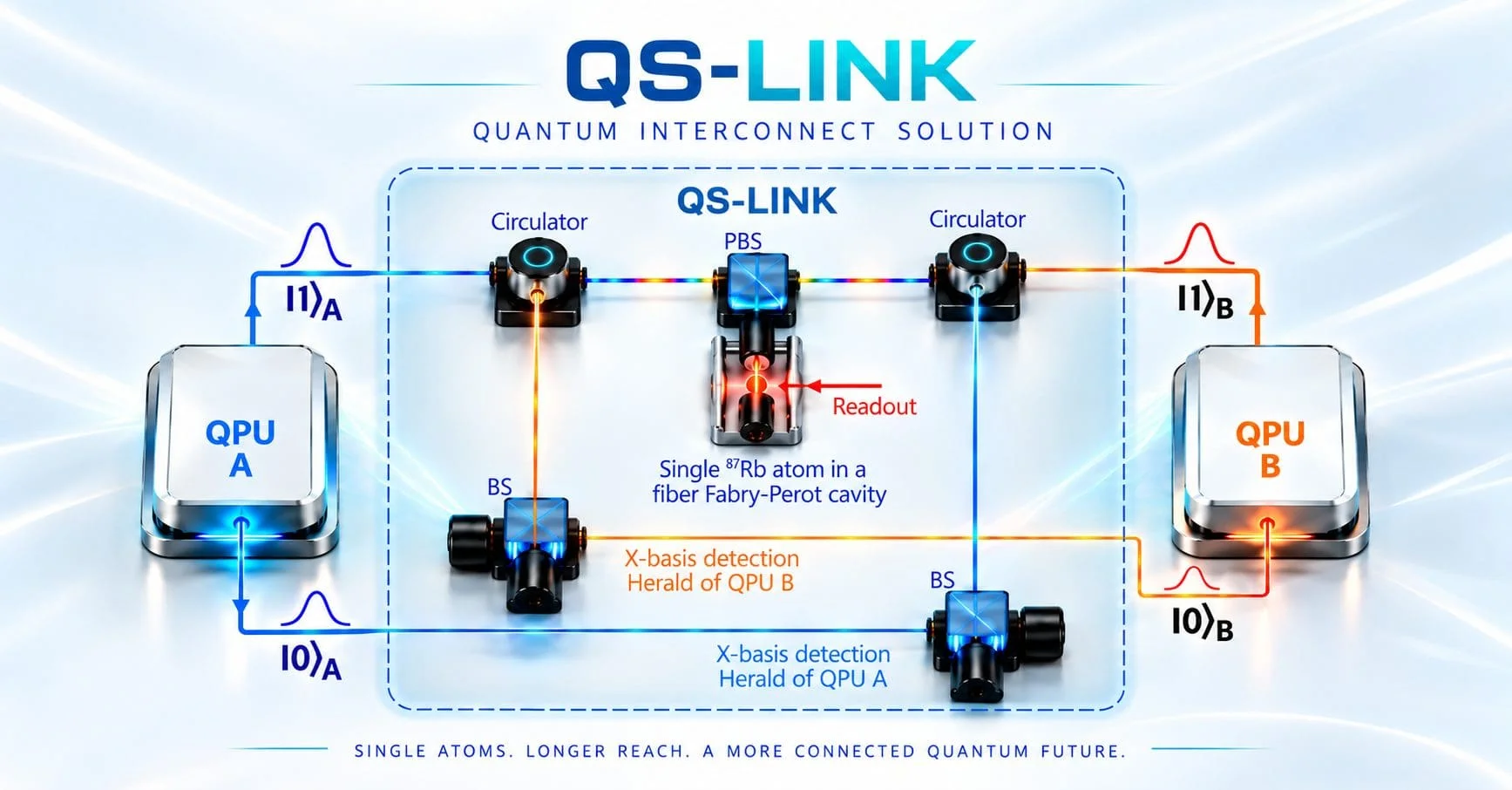
Quantum Source Labs is carving out a distinctive path in the quantum computing field by significantly enhancing entanglement rates among quantum processors. Their pioneering single-atom memory system marks a pivotal step forward by removing the stringent timing requirements that have long been essential for effective photon interactions. This development is not a small feat; it could be integral to the evolution of scalable quantum architectures, pushing the boundaries of what’s possible in quantum technology.
Naftali Bennett, a former Prime Minister of Israel and a current board member of Quantum Source, made a bold statement: “Photonic quantum computing offers the most scalable path to fault-tolerant quantum computers.” His confidence underscores a rising optimism surrounding the hybrid model embraced by Quantum Source. Notably, their recent success in generating entangled photon pairs on demand—delivered reliably over distances greater than one kilometer using standard optical fiber—demonstrates real progress towards making quantum communication practical and accessible.
Advancing Atom-Photon Integration for Quantum Systems
Quantum Source's cutting-edge demonstration of trapping and coupling single atoms onto planar photonic chips is a landmark achievement in the quest to develop efficient quantum interfaces. By enabling predictable interactions between individual atoms and photons, this innovation not only facilitates on-demand photon generation, but also significantly contributes to the important task of forming photonic cluster states. The recent research papers published by the company detail these breakthroughs, shedding light on the underlying processes that make such interactions possible.
This advancement serves as the backbone of their ORIGIN cavity-QED engine, which is designed to support QS-ORBIT—a fault-tolerant photonic quantum computer fitting within standard server setups without needing cryogenic cooling. This shift towards a less temperature-dependent quantum computing model could be particularly appealing for commercial sectors, where traditional cooling methods might be impractical or too costly. Their efforts also pave the way for QS-LINK, a photonic quantum interconnect capable of linking various quantum processing units, thus addressing another pivotal hurdle in the scaling of quantum systems.
According to claims from Quantum Source, their groundbreaking technique drastically mitigates the complexities often associated with feed-forward processing and switching seen in probabilistic photonic systems. If true, this could mean that large-scale, error-corrected photonic quantum computing might not just be within reach; it could be financially viable as well. The enthusiasm surrounding their work is palpable, evidenced by industry recognition, including being named a top startup to watch for 2026. This kind of acknowledgment signals rising interest and confidence in their potential to disrupt the quantum computing sector.
Founded in 2021 and based in Tel Aviv, Quantum Source has built a team of 67 professionals. They boast an impressive roster of investors, including Ayal Itzkovitz (Pitango), Seth Winterroth (Eclipse), and Dov Moran (Grove Ventures). Bennett’s strategic board role adds a layer of credibility and vision to their mission, blending government experience with tech innovations.
New Era of Deterministic Graph State Generation
The strides made by Quantum Source can be highlighted by their novel approach to implementing single-atom memory, which effectively eliminates the traditional timing constraints that have limited photon exchanges. This advancement brings a crucial capability: coupling individual photons with single atoms within a hybrid architecture. By doing this, they achieve deterministic resource-state generation compact enough to function within typical server environments—a concept that could revolutionize quantum computing accessibility.
This capability is particularly significant as it enables the generation of deterministic graph states, which are essential for complicated quantum computations. Thus, Quantum Source is addressing a fundamental challenge that has long challenged many existing photonic approaches—uncertainty. CEO Oded Melamed has characterized this advancement as a foundational blueprint for assembling a fault-tolerant hybrid photon-atom quantum system, effectively working around the persistent issues of fault tolerance and connectivity that other quantum hardware components have struggled with.
Implications and Future Outlook
So, what's at stake here? The advances made by Quantum Source could reshape the trajectory of quantum computing, particularly in how we understand scalability and accessibility. If you're working in this space, the convergence of atom-based qubits and photonic systems might not just represent a technical achievement, but a potential shift in the playing field. It’s about more than just performance metrics; it speaks to a future where quantum computing could transition from niche applications to mainstream utility.
As this technology matures, it could catalyze broader adoption across industries, changing how businesses approach computing challenges that currently seem insurmountable. The combination of cost-effective error correction and reduced complexity could lead to a new generation of applications that leverage quantum capabilities in ways we haven’t fully imagined yet. And yet, as Quantum Source continues to innovate, the critical question remains: will their solutions stand the test of time against the inevitable advancements from competitors also racing towards viable quantum applications?



Discussion
Sign in to join the discussion.