Researchers found sR-beta in the placenta, where its oxygen sensitivity may offer clues to pregnancy disorders and fetal neurovascular health.
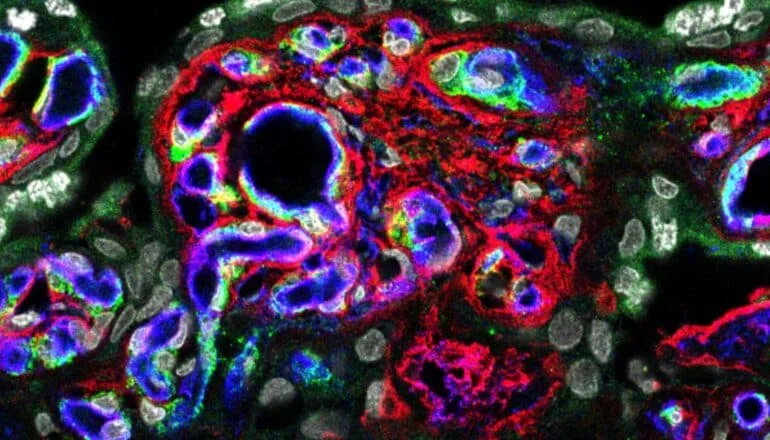
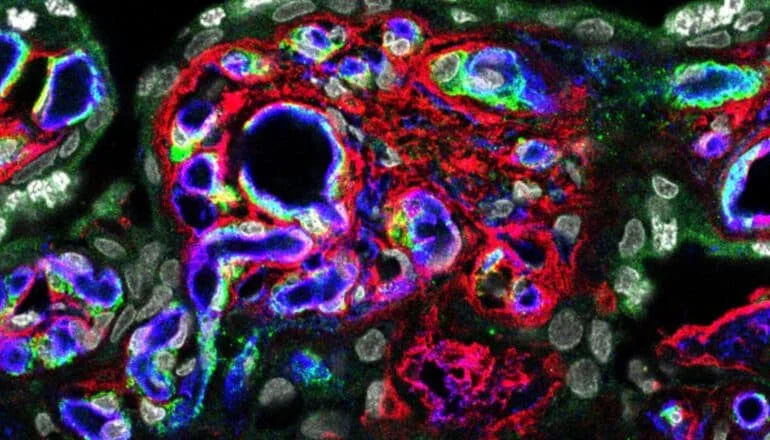
A protein found in developing placental vessels
A protein previously associated with the death of support cells in the brain also appears in the developing placenta, where it may help regulate blood vessel formation. That finding expands what researchers know about soluble platelet-derived growth factor receptor beta, or sR-beta, and raises questions about how changes in its production might affect fetal development. The study identifies a new setting in which the protein is present, but it doesn't yet show what the protein does there.
The work, led by John Chappell at the Fralin Biomedical Research Institute at VTC, was published in Angiogenesis. Chappell, a vascular biologist who also holds an appointment in Virginia Tech’s biomedical engineering department, and his team found sR-beta in placental tissue during vascular development. That matters because blood vessels are central to the placenta’s role in supporting a pregnancy, and their development provides a place to investigate how the protein might act.
Here’s the thing: finding a protein in tissue is a starting point, not a demonstration of its function. The researchers’ observations open a question about sR-beta’s role in placental blood vessels; answering it will require studying how the protein behaves as those vessels develop and under different conditions.
A different role for sR-beta
Until now, sR-beta was understood mainly as a marker of pericyte cell death in the brain. Pericytes help support blood vessels, but the new findings suggest the protein is present while vessels are developing, too. A protein associated with cell death in one context may have a different relationship to vessel development in another. The researchers say its role in the placenta remains to be established.
“Nature doesn’t put cells anywhere unless it’s on purpose. We believe sR-beta is likely involved in some sort of pathway modulation, to keep pericyte development in check,” Chappell says.
That proposed role is a hypothesis, not a result the study has settled. If sR-beta helps modulate a pathway involved in pericyte development, the protein could be part of how the placenta’s vessels form or respond to their surroundings. But the current findings don't establish which pathway is involved, or whether changing sR-beta would alter vessel development.
Audra Barnes-Lanier, the study’s first author and a former graduate research assistant in Chappell’s lab, says the team has established baseline levels of the protein in a healthy, developing placenta. They also found that sR-beta responds to oxygen levels, a feature that could make it relevant to pregnancy disorders such as preeclampsia. A baseline gives researchers a point of comparison for future work; it doesn't, by itself, show what levels would signal a problem.
“This new finding gives us baseline levels of this protein in a healthy, developing placenta,” Barnes-Lanier says. “We found that it is oxygen sensitive and may potentially serve as a new therapeutic target for pregnancy disorders such as preeclampsia.”
Oxygen sensitivity makes the protein a candidate for closer study because the placenta must support the exchange of oxygen and nutrients between mother and baby. Still, a possible connection to a disorder isn't proof that sR-beta causes it, or that the protein could be used to treat it. This is more significant than it looks: the finding gives researchers a specific feature to test as they examine placental stress.
Questions about pregnancy and brain health
The next research task is to determine how sR-beta changes when the placenta is under stress, and what drives any disruption in its production. Chappell says levels that are too high or too low could interfere with neurovascular development, with possible consequences ranging from acute complications to lasting effects. The key questions are still open: how levels change, what causes those changes, and whether they have measurable effects on developing blood vessels.
Among the outcomes he hypothesizes are brain bleeds, which occur when blood vessels leak or rupture, and retinopathy, eye damage linked to inadequate blood flow. These are possibilities the team wants to investigate; the study does not establish that sR-beta causes either condition. The distinction matters, since identifying a possible biological link is an early step toward understanding whether it has clinical relevance.
A first clinical application, Chappell suggests, could be using the protein as a biomarker to flag potential neurodevelopmental concerns. A biomarker could help indicate that further attention is warranted, but it wouldn't on its own explain the cause of a concern or determine what happens next. Better knowledge of how sR-beta works could also help researchers identify targets for preventing or limiting related problems.
“The next step of this project is to investigate how this protein changes during placental distress,” Barnes-Lanier says.
That next step will help determine whether the protein’s oxygen sensitivity is a useful clue or simply one characteristic of its activity in placental tissue. The answer could sharpen the research question: whether sR-beta changes alongside placental distress, and whether those changes relate to vessel development or later health.
What the finding could mean
The placenta supports pregnancy by carrying oxygen and nutrients from mother to baby, yet many details about how placental problems affect both remain poorly understood. Studying proteins present during its development may give researchers a way to examine how conditions in the placenta relate to the development of blood vessels and, potentially, the brain. And yet, a path from a finding in tissue to a useful clinical tool can involve many unanswered questions.
If you're working in this space, the immediate value is a new lead: sR-beta is present in developing placental tissue, has baseline levels in a healthy placenta, and responds to oxygen. Those observations create a basis for further study, but they don't establish a diagnostic test or a treatment. The evidence will need to show whether the protein's levels track meaningful changes during placental distress.
(And this is the part most people overlook.) A protein can be associated with a biological process without being the lever that controls it. Establishing whether sR-beta is a marker, a participant in vessel development, or both will shape how researchers interpret any later connection to pregnancy or neurodevelopment.
For now, the study changes the picture of where sR-beta is found and points to the placenta as a useful place to study early conditions that may shape a child’s health. A starting point, then—not a clinical answer.
The research was funded by a grant from the Seale Innovation Fund at the Fralin Biomedical Research Institute.
Source: Virginia Tech
The post Placenta protein may offer clues to brain development appeared first on Futurity.



Discussion
Sign in to join the discussion.