Prasad argues that randomized trials are feasible and essential for vaccine research. His rhetoric and record on evidence-based medicine warrant closer scrutiny.
What counts as evidence-based medicine?
Dr. Vinay Prasad has become a prominent voice on randomized trials, and his critics’ central question is straightforward: does his record support the authority he claims on evidence-based medicine? That question matters as he teaches a 19-part online course, How Not to Get Fooled by the Medical Literature, with fellow “medical conservatives.” The course continues despite recent events. Admirers praise his “lifelong commitment to scientific rigor” and call him “smart, driven by evidence, fearless, unafraid to take on the medical establishment.” Those are strong claims. His actual contributions to EBM deserve the same scrutiny he demands of others.
The case for more randomized trials
In 2024, Prasad, Dr. Mariana Barosa, and EBM authority Dr. John Ioannidis published an opinion piece, “Evidence Base for Yearly Respiratory Virus Vaccines: Current Status and Proposed Improved Strategies.” They argued that researchers need better experimental evidence on influenza and COVID-19 vaccines, and that trial designs could be adapted to make results useful across respiratory-virus seasons:
Well-conducted experimental studies, particularly randomized trials, are necessary to address persistent uncertainties about influenza and COVID-19 vaccines. We propose a new research framework which would render results relevant to the current or future respiratory viral seasons. We demonstrate that experimental studies are feasible by adopting a more pragmatic approach and provide strategies on how to do so. When it comes to implementing policies that seriously impact people’s lives, require substantial public resources and/or rely on widespread public acceptance, high evidence standards are desirable.
The assertion that trials are feasible carries much of the argument. A section of the paper, titled “Clinical Trials Are Necessary and Feasible,” says:
These cases demonstrate that RCTs are feasible and not prohibitively expensive if one incorporates pragmatic elements… what is most needed is robust effectiveness data on important clinical endpoints, such as severe illness, hospitalizations and death.
That’s more than a call for better research. Prasad has used the feasibility argument to challenge people who say trials aren’t practical, framing their position as a rejection of high evidence standards. In “The Scientists Who Undermine Randomized Trials,” he wrote:
In the last few weeks there have been several examples of scientists trying to undermine randomized trials— arguing they are not possible, not practical, or not useful. All of these arguments are false, as I will detail.
He has also promoted the slogan “RCT or STFU for all” and accused opponents of “hating EBM.” He described the critics in this dispute as “left-wing public health,” suggesting they were actively working against randomized trials.
His rhetoric has been sharply personal. In one video, he berated public health officials, rejected the idea of forgiving them, and demanded they “admit they didn’t run any studies,” despite his claim that he “told them to.” In another profane outburst, he attacked physicians who challenged his anti-vaccine claims as “fucking morons… who don’t know anything about evidence-based medicine.”
Prasad has tied this dispute to electoral politics, too. In a pre-election debate, “Which US Presidential Candidate is More Anti-Science?”, he argued that Kamala Harris posed the greater risk, chiefly because:
Harris will continue approving annual COVID19 boosters, including for kids as young as 6 months old, without randomized trials.
As MAHA and MAGA gained prominence, he described COVID booster approvals without RCTs as the greatest threat to science, and argued that Trump and Kennedy should take charge to avert what he portrayed as an EBM crisis. The argument is striking: the demand for rigorous evidence became a reason to advocate for particular political appointments.
Proposed trials versus completed work
Prasad often contrasts his own judgment with that of public health officials, whom he portrays as inept or hostile to randomized research. He has also described what he would do in their place: “I would conduct randomized experiments.” But a hypothetical plan and a completed trial are different kinds of contribution. If you’re assessing his standing in EBM, that distinction matters.
For this article, I disclosed my use of AI and asked ChatGPT to review Prasad’s tweets, articles, blogs, and videos, then list the randomized trials he had “called for,” “proposed,” “argued for,” or said he “would have” conducted. Here’s what it returned:
The evidence gap extends well beyond COVID
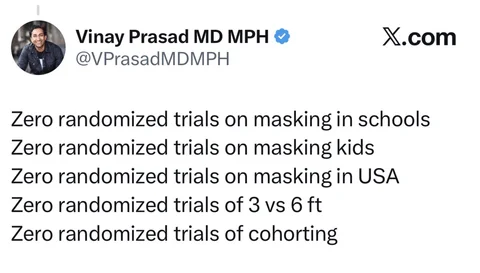
Prasad’s central point is that public-health decisions were made without randomized evidence for many interventions that could have been tested. The list is striking for its breadth: school and workplace closures, community mask mandates, masking children and schools, masking in the United States, and masking after vaccination. It also includes whether health-care workers should keep masking indefinitely, whether people who reliably wear masks benefit from continuing, and which mask strategies work best. The same argument applies to distancing and indoor precautions. Prasad called for trials comparing three feet with six feet of distance, different cohorting approaches, HEPA filtration in schools and homes, portable air cleaners or CR boxes, and plexiglass barriers. He also proposed a factorial trial that could compare masks, hand sanitizer, plexiglass, partitions, and face shields—an approach designed to estimate what each measure contributes. College mitigation plans, routine asymptomatic testing, testing in preschools and schools, quarantine duration, and restaurant rules for when customers should mask all appear in the inventory. The scope matters. This isn’t a claim that every intervention was ineffective; the table identifies questions for which Prasad said randomized trials were absent or should have been done. That distinction is easy to lose in arguments about the pandemic. The evidence gap itself doesn’t tell us which policy would have won. It does show how often officials had to act without a clear comparison.From pandemic policy to medicines and vaccines
Prasad applied the same standard to COVID treatments and vaccines. He argued for trials of alternative vaccine dosing schedules, bivalent boosters measured against an appropriate control, and boosters in vaccinated or previously infected people at low risk. He also said a large trial of COVID vaccination in healthy children ages 5–11 should have been conducted. For Paxlovid, he called for randomized evidence in vaccinated or previously infected people before extending results from EPIC-HR to them, and identified low-risk vaccinated adults and people with long COVID as populations that needed study. COVID anticoagulation, he said, required trials comparing full-dose, intermediate-dose, and prophylactic treatment. His broader regulatory argument is pointed: vaccines and boosters should be tested against outcomes patients feel, such as hospitalization, severe disease, and death, rather than relying only on intermediate measures. He extended that case to annual COVID vaccine updates and influenza shots, proposing multi-arm flu-vaccine trials that repeatedly compare formulations and advance the best-performing option. He also raised randomized studies of vaccine deployment, influenza challenge trials, vaccine coadministration, and vaccination during pregnancy. For childhood vaccines, he proposed a cluster trial comparing the U.S. schedule with Denmark’s, tracking hospitalization, all-cause mortality, diseases targeted by the additional vaccines, and neurocognitive development. That’s a wide-ranging proposal, and the fragment doesn’t explain how such a study would handle the practical and ethical challenges. But its underlying question is clear: when schedules differ, can those differences be evaluated directly instead of inferred from antibody responses? Prasad’s vaccine proposals reach beyond COVID and influenza. He argued that pneumococcal vaccines should demonstrate a reduction in pneumonia, rather than rely on antibody titers alone, and that most new vaccines should be tested in randomized trials using patient-important outcomes before approval. When manufacturers seek to expand a vaccine’s use to a new population, he said that population should be included in premarket trials instead of relying on immunogenicity to extrapolate benefit. He also called for better randomized evidence on the benefits and harms of giving multiple vaccines at the same time.Trials as a test of medical practice
The examples aren’t confined to infectious disease. In cancer, Prasad cited teclistamab in relapsed disease as a case where people wrongly claimed a trial couldn’t be done. He argued that treatment for smoldering myeloma could be compared with observation using survival as an endpoint, and that new cancer drugs could be tested against controls with overall survival in view. He also questioned routine practices in general medicine. Examples include distributing free COVID tests, using coronary-artery calcium testing to guide care, and deciding how often healthy adults should receive CBC, BMP, or CMP blood tests. He pointed to randomized evidence on the frequency of primary-care visits for healthy people and argued that such questions should be revisited. For whole-body MRI screening, he proposed a large trial powered to detect a difference in all-cause mortality; for prostate-cancer screening, he suggested comparing no screening, screening, and a patient-choice approach. The list ends with questions that resist easy answers: a multi-arm trial of alcohol-consumption strategies, and randomized comparisons of U.S. and Danish-style childhood vaccine schedules. Across these examples, Prasad’s demand is consistent: if a practice affects health and can be tested, measure its effect on outcomes that matter. That’s a demanding standard, and the proposals vary in feasibility. But the sheer number of unanswered questions makes the narrower claim hard to dismiss: medicine often adopts policies and products before it knows how much they help.RCTs were a demand for others
The pattern in Vinay Prasad’s appeals for randomized controlled trials is hard to miss: he pressed for them when he opposed a policy, especially COVID precautions and vaccines, but dismissed trials once they existed. Studies of boosters, pediatric vaccination, and vaccination in babies and toddlers drew calls for yet more research. Prasad’s critics have argued that this endless demand served to sow doubt rather than advance medical research; I discussed that argument in “Doctors Who Performatively Fetishized RCTs Aren’t Out to Advance Medical Research, But Rather to Sow Doubt & Mistrust.” The standard shifted when the evidence challenged positions Prasad favored. He didn’t call for randomized trials of “focused protection,” and he praised observational research alleging vaccine harms, including a VAERS analysis he called a “bombshell finding from dream team of authors.” He also described it as “natural and healthy” for children to catch SARS-CoV-2. The vaccine faced demands for the highest standards of EBM; the virus, in these arguments, faced none. Now that MAHA and MAGA hold power, Prasad has stopped demanding that the medical establishment run trials, according to the author’s account. Asked whether Prasad had criticized Robert F. Kennedy Jr. and MAHA for failing to conduct enough RCTs, ChatGPT found no clear example. Its answer was more limited: Prasad had called for trials while discussing Kennedy’s agenda, but had not plainly said Kennedy or MAHA were failing because they hadn’t done enough of them. That gap matters. “RCT or STFU for all” sounds like a universal principle. In practice, the author argues, it meant: demand trials from your opponents, then keep moving the bar when they arrive.Calling for trials is easier than running them
The section’s sharper test is whether Prasad helped conduct the trials he demanded. The author says ChatGPT found no evidence that he had. In 2018, oncologist Eliezer Van Allen had already challenged him to move beyond commentary:The author says Prasad later promised new RCTs on FDA podcasts (one, another, and a third), but didn’t deliver them. A Pfizer and BioNTech COVID vaccine study also failed to recruit enough participants while Prasad led the FDA’s vaccine division. The companies said: “We intend to stop the study due to slow enrollment and therefore the inability to generate relevant post-marketing data.” The trial had been described as feasible by Prasad and John Ioannidis. That outcome puts the feasibility question squarely on the table. The author’s criticism isn’t that randomized trials lack value. It’s that Prasad used their value as a cudgel against public health officials, while the practical work of making them happen was left to others. The author also points to Prasad’s FDA record: he faced criticism over management, rejected a Moderna flu vaccine application despite a successful RCT, and was later overruled by FDA regulators who approved the vaccine. Vaccine companies then announced plans to scale back vaccine research amid the MAHA climate. The broader consequences, in the author’s view, reach beyond Prasad’s record. The article points to Donald Trump and Kennedy warning about chemtrails, Kennedy appearing with Andrew Wakefield at an anti-vaccine conference, and the promotion of unproven treatments. It also cites NIH grant terminations disrupting hundreds of clinical trials affecting more than 74,000 participants. Prasad, the author argues, endorsed and empowered the people behind that agenda.You are an oncologist at an academic medical center. You clearly have knowledge & feelings about trial design. You even did some power calculations already. So… write some grants, write some protocols, get some buy in, and do something to be part of the solution.
Just saying the same thing over and over again, whether in social media or in medical literature, ain’t gonna get it done.
Discussion
Sign in to join the discussion.