A recent study reveals genetic factors enabling Jonathan, the oldest living tortoise, to maintain resilience and longevity despite his 194 years.
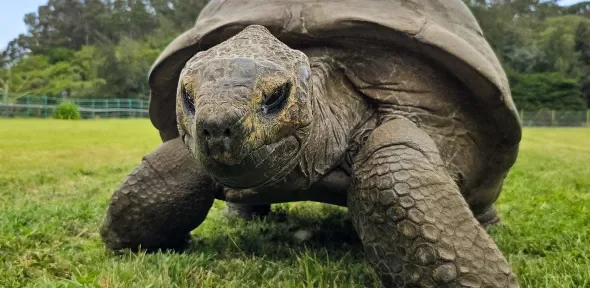
In a recent publication in Science Advances, researchers unveiled significant findings regarding the genetic makeup of Jonathan, the world’s oldest living giant tortoise, estimated to be 194 years old. An astounding 287 unique gene variants were identified that play vital roles in mitigating the typical effects of aging. These variants influence essential bodily processes such as DNA damage repair, inflammation reduction, insulin regulation, and cancer suppression.
Understanding Jonathan: A Fascinating Living History
Jonathan, an Aldabra giant tortoise (Aldabrachelys gigantea), has fascinating historical connections, having hatched in 1832, making him a contemporary of notable figures like Charles Darwin and Queen Victoria. His longevity has sparked curiosity and research among scientists focused on understanding the mechanisms of aging. Who would’ve thought that an ordinary tortoise could be a living witness to major historical events? This fact alone adds a remarkable human element to his status as a scientific specimen.
Epigenome Insights: What Keeps Jonathan Aging Gracefully?
The research team meticulously compared Jonathan’s epigenome, which consists of gene 'on/off' switches, with that of younger members of his species. Surprisingly, they found that the regulatory components for DNA repair and metabolic genes in Jonathan remain strikingly consistent with those of his younger counterparts. Typically, the epigenome undergoes changes as an organism ages, which contributes to various malfunctions commonly seen in older individuals. In Jonathan's case, it seems that genetic stability could be the secret sauce to his prolonged lifespan.
This investigation marks a significant milestone as it represents the first thorough exploration of the epigenome of a giant tortoise. Led by scientists from the non-profit organization Kallel, this research brings new insights into understanding the biological foundations of extreme lifespans. This kind of deep dive into the genetics of aging is rare, particularly for species that aren't commonly studied. The implications of these findings could extend beyond just tortoises and might inform broader biological aging studies.
The Stability of Jonathan’s Genetic Makeup
Dr. Justin Gerlach from the University of Cambridge noted, “We found that the gene regulators involved in energy production and DNA repair have remained incredibly stable in Jonathan over almost two centuries.” His extensive work on giant tortoises has enabled him to appreciate Jonathan not only as a study subject but as a collaborator in scientific inquiry. This perspective is intriguing; seeing Jonathan as a partner in research rather than merely an object of study emphasizes the ethical considerations in how we approach aging research.
Gerlach's focus has traditionally been on the ecology and conservation of giant tortoises, but this endeavor highlights a vital aspect of their longevity—how evolution has shaped their genetic resilience. When different species adapt over extended periods, they often gain unique traits. In Jonathan's case, it's about more than survival; it's a fascinating narrative about endurance and adaptation against environmental challenges.
Translating Insights into Practical Solutions
Stephen Clark, MD, PhD, a principal author of the study and Kallel's founder, emphasized the need to translate these evolutionary findings into practical health solutions. "Nature has already solved the puzzle of aging in remarkable ways, and Jonathan's genome provides a blueprint for cellular resilience," he stated. He further added, "Our goal is to take these evolutionary insights and immediately translate them into practical, affordable treatments for everyday people. Ageing is the greatest risk factor for nearly every chronic disease we face, and through the generosity of philanthropic partners, we can democratize access to longevity medicine." This is more significant than it looks; the potential applications of this research could revolutionize how we understand and treat age-related illnesses.
Jonathan's Life and Legacy: A Cultural and Ecological Reflection
For the majority of his life, Jonathan has resided in St Helena, a British Overseas Territory nestled in the South Atlantic Ocean. He was brought to the island from the Seychelles in 1882 as a gift to the territory's governor. His presence has become a cultural treasure, embodying both historical significance and a living link to natural history. Jonathan isn’t just another tortoise; he's a symbol of conservation efforts and ecological balance.
The Aldabra and Galapagos giant tortoises, of which Jonathan is a part, have withstood the test of time, serving as living links to the past of ecological dominance on many remote islands. Tortoises like Jonathan not only remind us of the resilience of nature but also serve as milestones in our understanding of environmental conservation strategies. Their longevity models can provide insights into how species can adapt over time, informing future ecological initiatives.
Implications and Future Outlook
The research received backing from the Voland Fund, showcasing a commitment to advancing the understanding of longevity and healthy aging. If you're working in this space, the implications are clear: as scientists begin to decode the enigma of longevity through Jonathan's genome, new avenues for improving human health could emerge. Aging isn’t just a personal journey; it's a public health issue that affects societies worldwide.
As researchers continue to study Jonathan’s genetic makeup, we might soon see tangible benefits that could revolutionize how we tackle aging. The findings could pave the way for treatments that not only prolong life but enhance life quality. But there are challenges ahead, particularly in translating this understanding into real-world applications. You have to wonder—will these discoveries remain on the fringes of scientific inquiry or become part of mainstream medicine?
Reference
Vaisvil, B et al: Epigenetic insights into extreme longevity in the world’s oldest terrestrial animal, Jonathan. Science Advances, Oct 2026. DOI: 10.1126/sciadv.adw8887



Discussion
Sign in to join the discussion.