Fujitsu and TU Delft's new quantum module leverages diamond-based qubits for modular designs, simplifying cooling and enhancing experimental access.
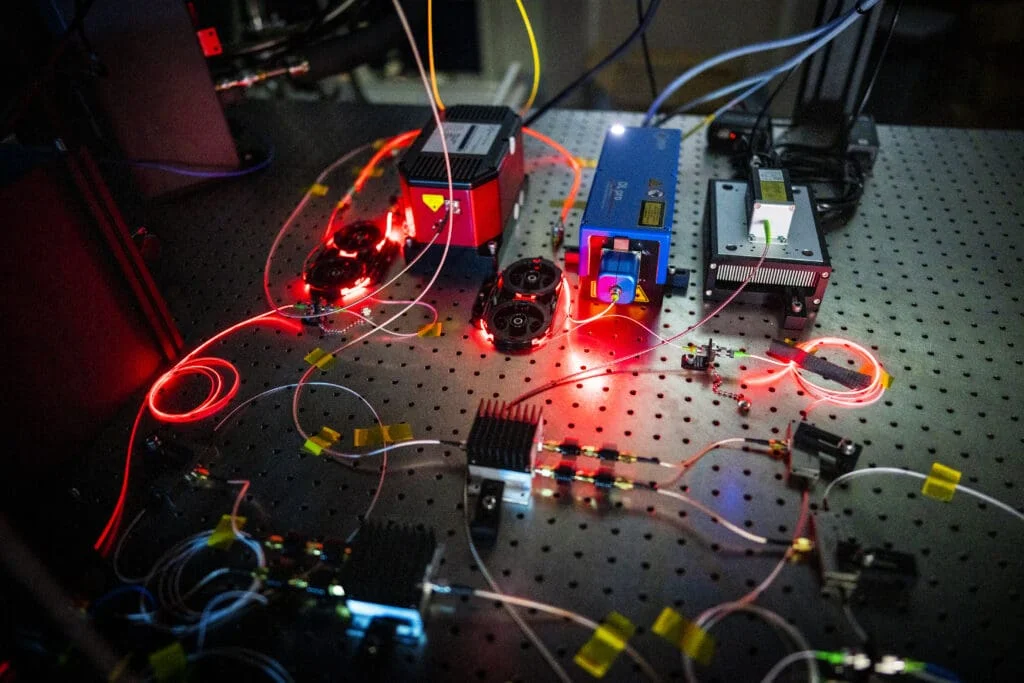
Fujitsu, alongside TU Delft and QuTech, has introduced an experimental quantum module that operates at an impressively low temperature of 1.55 kelvin (−271.6 °C). This approach aims to reduce the extensive cooling requirements typical of quantum computers. Their prototype employs tin-vacancy (SnV) centers in diamond, offering a fresh alternative to established qubit technologies such as superconducting circuits and trapped ions while facilitating designs that connect through optical links.
Leveraging SnV Centers for Enhanced Qubit Interfacing
The core of this prototype is a microscopic piece of diamond housing a single tin-vacancy (SnV) center paired with an alumina optical waveguide. This combination opens a route for photon-mediated interactions among qubits, addressing a significant hurdle in scaling quantum systems beyond traditional chip configurations. The project envisions future quantum processors that are interconnected through optical methods, enhancing coherence over larger distances, which is essential for practical applications in quantum computing.
Launched in 2020, the collaboration focused on SnV centers, known for their advantageous optical characteristics. These atomic defects in diamond serve as effective links between stable spin qubits and photons capable of carrying quantum states. By utilizing emitted photons routed through the alumina waveguide—a part of a broader photonic integrated circuit—the team has showcased a mechanism for transmitting quantum data. This signifies a potential shift from architectures dependent primarily on superconducting circuits or trapped ions, both of which have their own limitations regarding coherence times and scalability.
Many researchers believe that diamond spin qubits can provide a crucial bridge for quantum communication—and not just for quantum computing. Their relatively long coherence times when coupled with light can facilitate quantum networking. The integration of diamond spin qubits and on-chip photonics represents a pivotal advancement toward scalable quantum architectures, overcoming the limitations inherent in direct electrical connections. Researchers assert that this prototype successfully demonstrates this concept at the system level, laying the groundwork for future innovations that could propel quantum computing forward.
Modularity Validated: A Step Forward in Quantum Architecture
The new prototype exemplifies a validated modular quantum architecture by merging diamond-based spin qubits with integrated photonics, aimed at alleviating the cooling challenges seen with many current quantum systems. Rather than aspiring to create a large-scale quantum processor immediately, the focus is on resolving a fundamental issue for future quantum computers: enabling disparate components to integrate beyond the confines of a single chip. This shift is more significant than it looks, as it could change how modularity is approached in quantum computing.
This prototype lays groundwork for subsequent systems by unifying spin qubits, photonic integration, chip fabrication, and overall hardware control within one platform. Researchers will have access to this experimental prototype through Fujitsu’s Hybrid Quantum Computing Platform, facilitating further experimentation and development of the technology. It’s this practical accessibility that might spur new research initiatives and partnerships, potentially accelerating progress in the field.
While various quantum hardware platforms—including superconducting circuits and trapped ions—continue to be explored, the diamond spin qubits stand out for their ability to commune with light effectively. The collaboration has stressed the significance of uniting these elements as an engineering milestone toward scalable quantum architectures. So far, the prototype demonstrates a single quantum module, yet the team is aiming to construct a system composed of multiple interconnected modules by 2027. Achieving such interconnectedness could open new vistas in quantum computing, allowing for more complex computations and potentially enabling real-world applications, like advanced simulations in materials science or pharmaceuticals.
In parallel, QuTech has inaugurated a Quantum Systems Integration Unit that aims to build full-stack superconducting quantum computers reliant on a European supply chain. Achieving scalability with a substantial number of high-quality qubits persists as a significant engineering challenge. Nevertheless, this prototype marks an important preliminary step, validating the essential technologies necessary for future optically-connected quantum computing systems. It illustrates a growing trend in quantum computing—greater collaboration among universities and industry leaders for tackling unprecedented challenges in computing.
Implications and Future Outlook
What does this mean for you, especially if you're working in this space? The integration of photonic techniques with diamond-based qubits could pave the way for a more modular and scalable design approach for quantum processors. It’s a shift from just making individual qubits work to creating systems that can operate collaboratively. This type of system not only addresses cooling concerns but could also enhance performance metrics like coherence time and error rates.
For investors and tech enthusiasts alike, keeping a close eye on developments from Fujitsu and its partners could be critical. The potential for real-world applications grows every day, and the trajectory indicates a promising path toward commercialization. The research community is waking up to the idea that combining various platforms may yield results that single technologies alone cannot achieve.
And this is the part most people overlook: the success of next-generation quantum systems hinges not just on engineering and technical prowess, but also on how well these components harmonize. In this context, Fujitsu's work isn't just about a cooler quantum computer—it's about redefining the entire approach to how we think about quantum systems. If it achieves its goals, we could witness a paradigm shift that aligns quantum computing more closely with classical computing infrastructures, ultimately bringing that future a bit closer to reality.



Discussion
Sign in to join the discussion.