Storm snow deposited up to 3,200 microplastic particles per square meter per day at remote Sierra Nevada sites, with higher counts near Mammoth Mountain.
Microplastics are reaching Sierra Nevada snowfields far from towns and roads, carried through the atmosphere and deposited during storms. A new study measured as many as 3,200 particles per square meter per day at remote sites, underscoring how far pollution from everyday plastic use can travel. The finding extends a familiar problem into places that can seem removed from routine sources of waste: small plastic particles move with air, then settle out of it. Their presence at isolated sites doesn’t identify where each particle began, but it does show that distance alone can’t keep them away.
The results matter beyond the mountains: Sierra Nevada snowpack supplies about 30% of California’s freshwater. The researchers didn’t measure how much of the plastic enters drinking water or assess its health effects, so the findings describe deposition rather than exposure. That distinction matters: particles landing on snow aren’t the same thing as particles reaching a tap, and the study doesn’t trace what happens after snow melts. It establishes a potential route into a major water source, while leaving the size and consequences of that route unanswered.
Snow carries airborne particles to the ground
Snowflakes collect small particles suspended in the air as they fall, a process known as scavenging. That helps explain why the team recorded substantially more plastic during snowfall than in dry weather. In effect, a storm can sweep particles out of the air and concentrate them on the ground, making snow useful for measuring what’s passing overhead. Plastic fibers can enter the air from clothing, including through dryer vents and routine wear; wind can also lift fragments from the ground and carry them elsewhere. Those pathways make airborne plastic a mixture of possible sources, rather than a signal that points neatly to one activity.
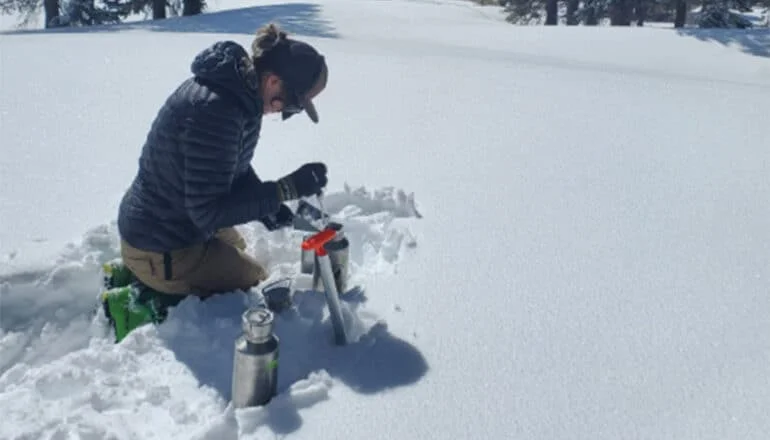
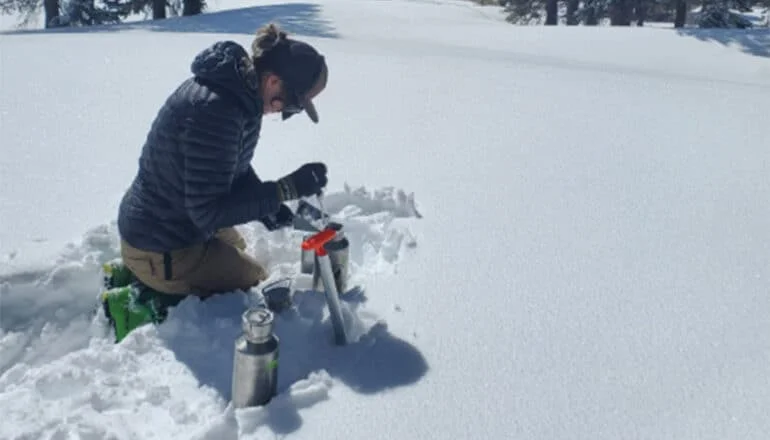
Lead researcher Aleksandra Karapetrova, an environmental toxicologist at the University of California, Riverside, expected to find little or no plastic at some of the most isolated locations. Reaching the sites required a chairlift for one and skis for the others. The difficulty of getting there gives the result a clear point: the particles weren’t limited to easy-to-reach sampling spots near roads or buildings. Still, remoteness describes the locations, not the route each particle took to reach them.
“One site was accessed by chairlift. I had to ski to the rest of the remote sites. That’s how isolated they are,” Karapetrova says. “But no matter how far out the site, I always found microplastics there.”
Across seven locations, storm snowfall deposited 270 to 3,200 particles per square meter each day at remote sites. At one location in the Mammoth Mountain ski area, the measured rate was about three times higher: 2,600 to 7,500 particles per square meter per day. Nearby human activity and greater snowfall accumulation may help account for the difference. The comparison suggests that local conditions could affect what gets recorded, even within the same broader mountain region. It doesn’t, by itself, establish how much each factor contributed.
“I didn’t think the plastics would stay suspended so much in the town,” Karapetrova says.
The particle counts can sound large, but the total mass is small. At the highest estimated rate, a day’s snowfall over an acre would deliver about 1.5 grams of plastic. That’s a useful reminder that a high count of tiny particles doesn’t necessarily mean a large amount by weight. Both measures tell part of the story: counts show how many particles are arriving, while mass gives a sense of their combined material. Neither measurement alone tells readers what happens to the particles after they settle.
Airflow points toward possible sources
To investigate where the particles might come from, the team traced air masses associated with the sampled storms. Most had passed over Fresno and Madera counties, making the Central Valley a possible contributor. The computer models couldn’t pinpoint specific sources or rule out particles arriving from farther away. Airflow can indicate where a storm’s air has traveled, but it can’t assign a particle to a particular road, building, product or source. The county connection is a clue about transport, not a definitive source map.
Earlier research had found microplastics in Western U.S. snow. This study adds measurements of deposition during individual storms, linking the particle counts to specific weather events. That focus helps show how the particles arrive, rather than simply documenting that they’re present in snow. To confirm what they had collected, researchers used infrared light to read each particle’s chemical signature and compared it with a reference library. That step helped distinguish plastics from soil and plant material, a necessary check when samples contain a mix of natural and human-made debris.
The most common materials were polyethylene, polypropylene and polyester/PET, which are widely used in packaging and clothing. The team also identified cellulose derivatives: chemically modified, plant-based materials used in consumer products. The material list is consistent with several familiar product categories, but the study doesn’t identify the original products behind individual particles. Here’s the thing: identifying a polymer narrows down what a particle is made of, but it doesn’t tell you who made it or how it traveled to the sampling site.
Some chemicals used in plastics have documented links to hormone disruption, inflammation and cellular damage, but this study didn’t test for health effects from the particles found in snow. Its finding is narrower and striking on its own: plastic pollution reaches remote mountain sites through the air, during storms and in dry weather. This is more significant than it looks because it shows that pollution can cross the boundary between populated areas and apparently isolated environments. The study doesn’t establish a health risk from the measured particles. A transport finding, with important questions still open.
“We are at a point where microplastics are in our atmosphere, not just the ocean, not just rivers. It comes down with the snowfall, making its way to places humans typically don’t go,” Karapetrova says.
What the findings leave open
The study puts a measurable rate on plastic arriving with Sierra Nevada snow, but it doesn’t follow those particles through snowmelt or into water supplies. Nor does it determine how long the particles remain in the environment or what happens to them after deposition. Those gaps define what further research would need to establish before the measurements could be connected to exposure or effects. If you’re working in this space, the distinction between detecting particles and tracing their fate is the central point to keep in view.
That said, repeated detection across seven locations, including remote sites, makes the atmospheric route harder to dismiss as a local oddity. The higher readings at the Mammoth Mountain site also suggest that deposition can vary with conditions such as nearby activity and snowfall, though the study doesn’t isolate the contribution of each. For readers, the practical takeaway is bounded but clear: snow can collect airborne plastic, and mountain remoteness doesn’t prevent that arrival. Whether the particles then affect water or people remains unanswered by these measurements.
The study appears in Environmental Science and Technology. Its storm-level measurements add detail to earlier detections of microplastics in Western U.S. snow, while leaving the path from snowpack to exposure for future investigation.
Source: UC Riverside
The post There are significant amounts of microplastic in Sierra Nevada snow appeared first on Futurity.



Discussion
Sign in to join the discussion.