Health misinformation has moved from journals to search, social media, and AI chatbots. Science-based medicine must keep meeting audiences where they seek answers.
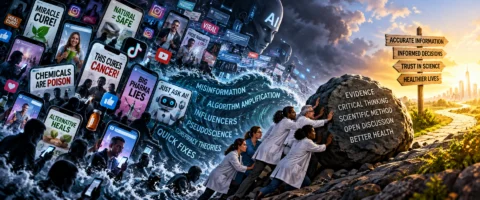
Science-based medicine’s fight has always been a fight over who gets to shape what the public hears about health. The battleground keeps changing: first academic journals, then search engines and Wikipedia, then social platforms. Now AI chatbots are becoming another place where medical claims meet an audience. That shift matters because a good answer from a chatbot can help—but a confident bad one can travel just as easily.
From journals to the public web
When my colleagues and I started SBM, we saw ourselves pushing back against unreliable health information reaching the public, the media, and regulators. We didn’t foresee how much the contest would change. We’re still trying to keep pace, but I believe the work remains worthwhile.
At first, the target was the growing acceptance of “alternative medicine” in mainstream institutions. Much of that debate played out in academia. One early effort was The Scientific Review of Alternative Medicine, a strong print journal edited by Wally Sampson. But we came to see that a journal wasn’t reaching the people or institutions where public opinion and regulation were being shaped. Mainstream health experts who weren’t already drawn to CAM weren’t reading it, either.
The journal’s eventual end helped prompt the creation of SBM, just as Web 2.0 and social media were taking shape. An online publication could respond faster and reach a wider public. That was the right call. People selling snake oil also recognized the opportunity, and they multiplied online.
Search, Wikipedia, and social media
Visibility in search results became the next contest. SBM and other skeptical sources often ranked well on medical searches, in part because search engines such as Google learned that source quality matters. Links from trusted sites helped. The precise ranking systems remain opaque, though, and reliable sources were increasingly outnumbered.
Wikipedia has been a more clear-cut success for science-based information. Its editors have managed persistent disputes while favoring evidence-based accounts over pseudoscience and self-promotion. Attempts to build rival reference sites went nowhere significant. If you’re looking for an example of a platform that has served science well, Wikipedia belongs on the list.
Social media is harder. Each platform has its own audience and habits, so maintaining a good blog doesn’t cover the ground. SBM has a presence across some of these spaces, but reaching all of them is ongoing work.
I’ve tried to help through my personal TikTok feed, which focuses mostly on SBM topics. The platform has a strong current of conspiracy claims and distrust of expertise; it can feel like a post-truth forum. My regular rebuttals help, but they’re a small response to a large stream of misinformation. The field needs younger, skilled advocates who can widen that effort and eventually carry it on as today’s writers step back.
AI answers become the next test
The next major venue may be AI. What popular chatbots tell people about medical questions could soon shape how they understand treatments and evidence. Early results are mixed. Chatbots draw much of their material from sources such as Wikipedia, which helps, but the wording of a prompt can change the answer. So can the balance of evidence and pseudoscience in the data used to train a model.
Two decades of SBM articles may be part of many models’ pretraining material. So is a great deal of CAM promotion and pseudoscientific advocacy. Which influence wins in a particular answer isn’t always obvious.
I asked ChatGPT, “what do you think about homeopathy?” It replied:
“My assessment of homeopathy is that it is a pseudoscientific system of medicine whose central principles are inconsistent with established chemistry, physics, and physiology, and whose clinical efficacy has not been demonstrated beyond placebo effects.”
That’s a strong answer. But homeopathy is an easy case; when asked about acupuncture, the chatbot gives a more equivocal response. The result is encouraging, with limits.
There’s also a case for building an SBM chatbot. An open model could be further trained on curated material, including the site’s archive, and guided with rules for how it should respond. That could help people seeking science-based information or doing research. I doubt a specialist bot would attract a broad audience, however. The larger prize is improving the answers from the products people already use. A dedicated tool may still be worth trying.
We’ll need volunteers willing to promote science in medicine and challenge the quacks and con artists who have gained ground over the past four decades. The information fight doesn’t end; its main channels keep changing.
About the author
Steven Novella, MD, founded Science-Based Medicine and serves as its executive editor. He is an academic clinical neurologist at Yale University School of Medicine. Novella also hosts and produces The Skeptics’ Guide to the Universe, writes the daily NeuroLogicaBlog on neuroscience and broader questions in science, skepticism, critical thinking, and media, and has created two courses for The Great Courses. His book on critical thinking is also titled The Skeptics Guide to the Universe. See all of his posts.
This article appears in Commentary and is tagged AI and social media.

Discussion
Sign in to join the discussion.