Fossils of *Yujingia glutenotunica*, dating back over 500 million years, reveal insights into the evolution of starfish and their unique body plans.
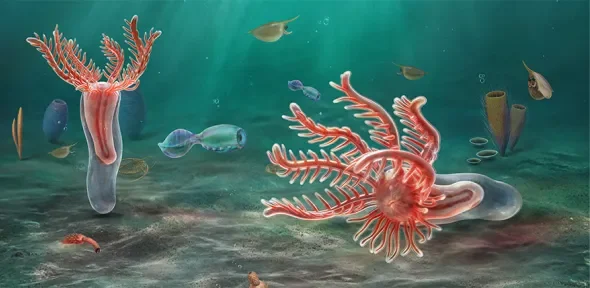
The discovery of a new fossil species, Yujingia glutenotunica, in southwestern China is changing our understanding of the evolutionary history of starfish and their relatives. This fossil, dating back over half a billion years, is thought to represent a close relative of the last common ancestor of ambulacrarians, the group that encompasses sea stars, sea urchins, and acorn worms.
A collaborative research effort, which includes scientists from the University of Cambridge, suggests these fossils could illuminate why two closely related lineages—starfish and chordates, the latter including humans—developed such divergent anatomical structures over time. The findings have been published in Current Biology.
This fossil was discovered during the Cambrian explosion, a significant period marked by the rapid emergence of most major animal groups in the fossil record. While many fossils from this era feature hard shells, the conditions at the Maotianshan Shales, where Yujingia was found, allowed for the preservation of softer body parts.
The specimens measure between 8 to 22 millimeters and offer rare insights into ambulacrarians that lack mineralized skeletons. Notably, these animals possessed two types of appendages: feather-like feeding tentacles for capturing organic matter and another set that likely anchored Yujingia to the substrate, although they were capable of some movement.
Co-author Dr. Giovanni Mussini from Cambridge noted a shift in our understanding of these ancestral creatures. “Traditionally, scholars envisioned the last common ancestor of ambulacrarians as more worm-like, dwelling in the seafloor and filtering food,” he explained. “This new fossil indicates that the ancestral form may have actually relied on feeding with tentacles, resembling starfish more closely.”
A New Perspective on Evolutionary Divergence
The classification of Ambulacraria as a major branch of deuterostomes dates back to the 1880s, incorporating echinoderms like starfish and hemichordates such as acorn worms. Despite this long-standing classification, the fossil record detailing their origins has remained sparse.
As Dr. Mussini highlighted, the stark differences in body forms—fivefold symmetry in starfish compared to the bilaterally symmetrical form of acorn worms—have puzzled scientists until now. The research suggests the evolutionary narrative involves a more complex transition than previously thought.
Traditional theories posited that the ancestral ambulacrarian was a simple organism without tentacles, which filtered food through its pharynx. The detailed anatomical and phylogenetic analyses of Yujingia provide concrete fossil evidence that challenges these ideas.
Lead author Kaiyue He from Northwest University in China described the fossil's features: “The animal has an elongated, bottle-like shape with tentacles extending from a rounded lower body. Its form is reminiscent of the yujingping, a ritual vase in Chinese culture, which inspired its genus name.” The soft, gelatinous structure of the species acts as its most distinguishable characteristic.
Implications for Understanding Evolution
To determine the evolutionary placement of Yujingia, Mussini and He analyzed 505 morphological traits across a dataset of 100 extant and extinct taxa using Bayesian phylogenetic reconstruction methods. This analysis positions Yujingia closer to the last common ancestor of existing ambulacrarians than any previously discovered fossils, bridging a gap between early Cambrian tentacled organisms and later echinoderms and hemichordates.
Despite the absence of a hard skeleton, Yujingia featured an advanced tentacle-based feeding system. This suggests that complex feeding structures emerged early in the evolutionary timeline, while the bony parts of echinoderms developed later.
Dr. Mussini emphasized the ecological implications of these findings: “Different lineages can take uniquely divergent evolutionary paths driven by their ecological niches. While chordates became more mobile to find food, leading to streamlined bodies and enhanced brains, starfish evolved to stay anchored, specializing in particle feeding.”
Co-author Degan Shu from Northwest University framed the discovery as pivotal in understanding early deuterostome evolution. “Yujingia links ancient tentacle-bearing seabed dwellers with modern echinoderms and hemichordates, providing important insights into the shift from bilateral to fivefold symmetry,” he stated. “This adds a critical piece of fossil evidence to the early animal evolutionary tree.”
The research involved a multidisciplinary team from Northwest University, the University of Cambridge, the State Natural History Museum Braunschweig in Germany, Georg-August University, and the China University of Geosciences. Funding for the study was provided in part by the Natural Environment Research Council (NERC), a segment of UK Research and Innovation (UKRI).
Reference:
Kaiyue He et al. ‘Cambrian fossils illuminate the ambulacrarian common ancestor.’ Current Biology (2026). DOI: 10.1016/j.cub.2026.08.053



Discussion
Sign in to join the discussion.