IonQ has set a new record with over 1,000 entanglement events per second, enhancing the capabilities of quantum interconnects for broader applications.
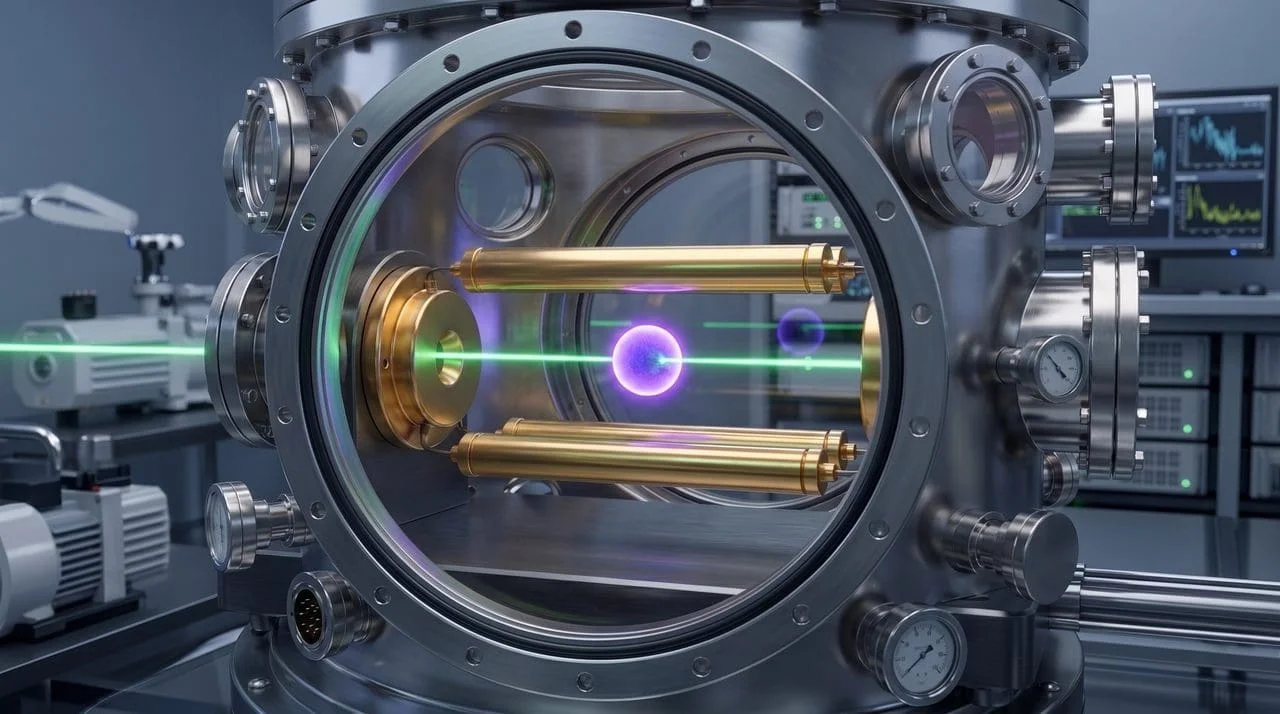
IonQ has reported a significant breakthrough, achieving an entanglement rate that surpasses 1,000 events per second between a trapped ion qubit and a silicon vacancy quantum memory. This milestone not only establishes a new benchmark for ion-based systems but also enhances the efficiency of light-coupling technology deployed within solid-state memories. “IonQ has crossed a pivotal milestone for memory-enhanced quantum interconnects, achieving more than 1,000 entanglement events per second,” remarked Niccolo de Masi, IonQ's Chairman and CEO. He emphasized that this advancement could significantly facilitate the creation of networked quantum data centers.
New Approaches to Distributed Quantum Computing
This exceptional entanglement rate lays a foundation for distributed quantum computing, essential for scaling quantum systems. Increasing the speed of entanglement has been a focus for researchers aiming to allow multiple quantum devices to work together efficiently. This effort is critical as quantum computing applications, from drug discovery to complex algorithms, often require the collective power of several qubits across various nodes. The innovative architecture behind this accomplishment is versatile enough to integrate with various qubit technologies, not limited to just trapped ions. This adaptability might facilitate interoperability across different systems, which could accelerate the development of hybrid quantum solutions.
By optimizing with appropriate transducer technology, IonQ is positioning itself to impact various quantum modalities, including modular computing and networked sensing. The capability to connect multiple systems has implications for how we think about processing power in the future. Instead of relying on a single large-scale quantum computer, we could soon see smaller, distributed systems that communicate entangled states, offering a flexible and scalable approach to computing that aligns well with modern data needs.
IonQ's commercialization strategies are already in motion, having secured system sales to the University of Maryland in April and to SDT in South Korea this September. These early transactions demonstrate the growing confidence investors and institutions have in IonQ's technological advancements. The company indicates that their decade-long research efforts have culminated in the realization that transmitting quantum information through photonic methods will be a crucial factor in large-scale quantum computers’ success.
“Our journey in developing quantum interconnects extends back to our foundation,” stated Chris Monroe, IonQ’s Chief Scientist and Gilhuly Family Presidential Distinguished Professor. In his comments, he highlighted that the advancements achieved indicate that such a photonic quantum interconnect does not need to be a bottleneck in efforts to pursue distributed quantum computing. That sentiment speaks volumes about IonQ's commitment to overcoming technical hurdles traditionally viewed as insurmountable in the quantum field. (and this is the part most people overlook)
IonQ has crossed a pivotal milestone for memory enhanced quantum interconnects, achieving more than 1,000 entanglement events per second.
Niccolo de Masi, Chairman and CEO of IonQ
Collaboration with DARPA Enhances Quantum Capabilities
This entanglement achievement is integral to IonQ's involvement in the Defense Advanced Research Projects Agency’s HARQ program, which aims to build high-speed cross-technology quantum interconnects compatible with various qubit frameworks. The collaboration is designed to broaden the technology's application, interfacing not only with trapped ions but extending to neutral atoms and superconducting qubit systems equipped with suitable signal transducers. Relying on DARPA’s significant resources could provide a substantial boost to IonQ, allowing it to refine and expand its interconnect technology even further.
IonQ frames this advancement in interconnect technology as a vital step toward realizing the ambitious vision of “networked quantum data centers of the future,” which hinges on overcoming challenges related to qubit communication. The technical nuances of this new link between a trapped ion system and a silicon vacancy qubit have been detailed in a recently released technical paper. The real-world implications of such advancements can’t be overstated: we could be on the cusp of a new era in computational power, where the synergy of distributed systems may unlock capabilities otherwise thought impossible.
This work shows that a photonic quantum interconnect need not be a bottleneck for distributed quantum computing.
Mihir Bhaskar, IonQ SVP and GM of Quantum Technologies at SkyWater
Implications and Future Outlook
The implications of IonQ's recent advancements span beyond academic curiosity; they touch on practical applications that can alter industries. If you're working in this space, consider how enhanced entanglement rates could redefine computational methods in fields like cryptography, financial modeling, and complex simulations. There's also the tantalizing possibility of accelerated timelines for quantum communication networks, which could fundamentally shift how secure data is transmitted.
While the current achievements are promising, we must remain cautious. The road ahead is punctuated by technical hurdles and the persistent challenge of scaling quantum systems. The deployment of such technologies on a large scale isn't guaranteed. Still, working partnerships with organizations like DARPA could catalyze necessary developments, potentially yielding results sooner than anticipated.
See today’s quantum computing news for the latest breakthroughs in qubits, hardware, algorithms, and industry deals.



Discussion
Sign in to join the discussion.