A recent profile in Boston Magazine scrutinizes Steven Pinker's role at Harvard, revealing deep divisions in academic circles surrounding his influence.
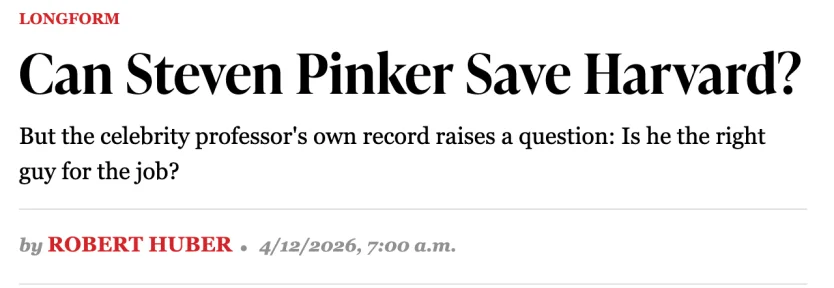
The recent Boston Magazine article titled “Can Steven Pinker Save Harvard?” dives into the polarizing figure of Steven Pinker, a notable cognitive psychologist at Harvard. The piece presents tired critiques against Pinker, ranging from his belief in progress to his perceived alignment with controversial figures, offering little new insight into his ongoing influence within the academic community.
Pinker was a key player in founding the Council on Academic Freedom at Harvard, now comprising around 200 members. This organization focuses on promoting freedom of speech, institutional neutrality, and combating biases within academic practices. The question of whether a single individual like Pinker can “save Harvard” feels misplaced, as it overlooks collective institutional responsibilities in academia. The article seems more like an attack piece than a thorough examination, failing to substantiate its claims with significant evidence.
Critics have long argued that Pinker's work lends legitimacy to unsavory ideologies, accusing him of ideological bias. The article spotlights various opposing views, but these counterarguments often lack depth and fail to fully engage with Pinker’s perspectives. For example, his critique of the prevailing blank-slate ideology has ruffled feathers among academics who see it as oversimplifying complex human behaviors.
Assessing Critiques of Pinker
The criticisms leveled against Pinker include claims that he oversimplifies complex ideas and engages too readily with controversial figures, potentially legitimizing their views. The backlash often magnifies each of his associations into a narrative that suggests complicity with problematic ideologies.
“Pinker is one of the most famous—and divisive—academics in America,” the article claims, summarizing his reputation. Yet, it’s critical to differentiate between criticism grounded in academic rigor and that which stems from ideological opposition.
For instance, Pinker’s work, including The Blank Slate and The Better Angels of Our Nature, challenges entrenched beliefs about human nature and the historical trajectory of violence. He argues for the role of genetics in shaping human behavior, a stance that inevitably attracts controversy. Some scholars, like Louis Menand, have rebuked him for perceived lack of nuance, yet his assertions spark necessary debate on nature versus nurture.
The Extremist Appropriation of Ideas
An unfortunate consequence of Pinker's visibility is that extremist groups have seized upon his writings to support their agendas. Critics use this to argue that Pinker's work enables far-right ideologies. However, reducing his scholarship to its misuse by others risks oversimplifying the implications of his ideas. Pinker himself asserts that one cannot control how others interpret their work.
The article notes, “Bad actors and dark thinkers have appropriated Pinker’s research… and Pinker has done little to stop them.” Yet, how might one reasonably expect an academic to police all interpretations of their publications?
Pinker’s Complex Legacy at Harvard
The question of Pinker's potential to enact change at Harvard involves more than personal ambition; it encompasses broader institutional dynamics. His involvement in the Council on Academic Freedom hints at an effort to foster a dialogue around contentious academic issues. However, whether this initiative will succeed remains speculative.
Pinker himself has expressed cautious optimism regarding the Council's efforts. He underscores the necessity for such discussions within academia. While the Boston Magazine article hints at skepticism about Pinker as a leader in these reforms, it highlights ongoing debates among Harvard faculty regarding free speech and academic standards.
The Better Angels of Our Nature has faced particular scrutiny,” with critics dismissing Pinker’s optimistic portrayal of human progress as naive. But his historical analysis presents compelling arguments for the reduction of violence over centuries; thus, it invites reconsideration of a pessimistic view of societal evolution.
In reflecting on his public associations, including regrets linked to his connections with Jeffrey Epstein, Pinker acknowledges the complexities of academia's social fabric. His nuanced position on legal representation illustrates a deeper engagement with constitutional principles, even in the face of strong criticism.
A Continuing Debate
As the piece concludes, the inquiry into whether Pinker can indeed “save Harvard” seems more relevant to institutional introspection than to his individual capabilities. Contrary to expectations, the article does not reach a firm verdict, leaving it to the university community and its leadership to navigate these turbulent waters themselves. Consequently, it prompts further examination about academic freedom, intellectual responsibility, and the often-contentious intersections of these concepts in contemporary education.
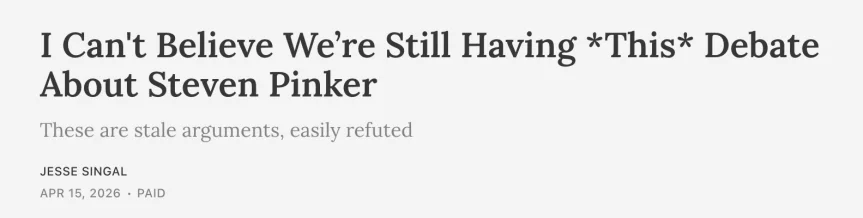
While Jesse Singal’s critique of the Boston Magazine article indicates frustration with the anti-Pinker sentiment that persists in academia, it also illustrates the larger struggle over intellectual discourse in a polarized environment. It remains essential for academics to actively engage with dissenting views while maintaining a rigorous standard of evidence and analysis.



Discussion
Sign in to join the discussion.