The 2026 Congo Ebola outbreak has surpassed 2018’s toll, with rapid spread highlighting how population movement and weaker response systems challenge containment.
An outbreak moving at a different scale
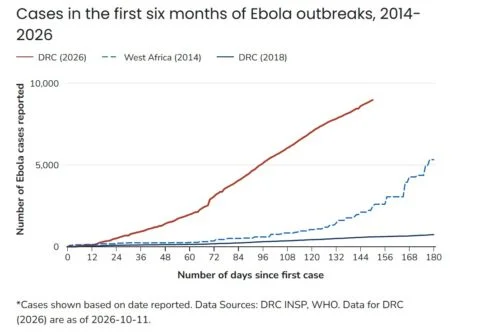
The 2026 Ebola outbreak in the Democratic Republic of Congo has reached 9,066 cases and 4,381 deaths, making it the second largest on record. And it’s still in its first year. The outbreak passed 1,000 cases in 40 days; during the 2018 outbreak, that threshold took 235 days, according to the CDC’s situation summary. Those figures make this more than a grim tally: they point to an outbreak spreading at a pace that could soon rewrite the historical record.
The speed matters because case counts describe more than the scale of suffering. They also indicate how quickly health workers and public services may have to identify cases, trace contacts, and organize care across affected communities. Those tasks become harder when the number of people needing attention rises faster than local systems can respond. The figures don’t, by themselves, explain why transmission is accelerating, but they do make the gap between this outbreak and the 2018 one difficult to dismiss. This is more significant than it looks.
Ebola, caused by viruses in the orthoebolavirus group, is deadly. The CDC describes the disease; some outbreaks have had mortality rates of 80% to 90%. But the virus spreads through direct contact with bodily fluids, not through the air. It persists in nonhuman hosts, so eradication isn’t a realistic option. Spillovers occur, often in rural African communities, and limited infrastructure and some local practices can help an outbreak spread.
That mode of transmission shapes the response. Containing Ebola depends on finding infections and limiting contact with infectious bodily fluids; the fact that it doesn’t spread through the air doesn’t make control automatic. Cases can go undetected, and people may move between communities before an outbreak is recognized. When health services are difficult to reach, getting timely care and identifying contacts can be harder. The virus’s persistence in nonhuman hosts also means that stopping one outbreak won’t remove the possibility of another spillover.
Why this outbreak stands out
Before 2014, Ebola outbreaks generally involved hundreds of cases and stayed within small villages. The largest before then was in 1976, when 280 people died. The 2014–16 outbreak was a sharp break: more than 28,000 cases and 11,000 deaths. In 2018–20, the toll reached 3,481 cases—3,323 confirmed and 158 probable—and 2,299 deaths. The current outbreak has already exceeded that second figure.
The comparison gives the current toll a historical scale, but it also needs care: outbreaks unfold in different places and under different conditions. Even so, the jump from hundreds of cases in earlier outbreaks to tens of thousands in 2014–16 showed how much the consequences can change when transmission reaches beyond a small community. The current outbreak has already surpassed the 2018–20 total. That makes the old assumption that Ebola will remain contained within a limited area a poor basis for judging the risk.
The obvious explanation isn’t that Ebola has evolved into a more dangerous virus. The current outbreak is caused by the Bundibugyo variant, which is less deadly than some other variants, and there’s no vaccine for it. A vaccine does exist for the Zaire variant; a 2025 outbreak of that variant caused 64 cases and 45 deaths. The recent jump in outbreak size points instead to changing human conditions: more people living close together in vulnerable areas, more travel between towns and villages, and outbreaks occurring in conflict zones where displaced people move frequently.
That distinction matters. A virus doesn’t need to become more lethal to cause a larger outbreak; transmission can rise when people’s movements and living conditions make exposure more likely or response more difficult. A vaccine for one variant also doesn’t solve the problem posed by another. If you’re working in this space, the practical question is therefore not only how deadly a particular variant is, but whether health workers can identify cases and interrupt transmission quickly enough. The numbers here are underwhelming for anyone hoping that a less deadly variant will be easy to contain.
Containment under pressure
That’s the problem this opening raises: even as outbreaks become harder to contain, the systems meant to detect and stop them appear weaker. The 2014–16 crisis prompted calls to build a faster international response, because a spillover near a population center or transport hub could grow by orders of magnitude. The goal was to halt outbreaks early while vaccines were developed. For variants without vaccines, containment remains the main defense.
Here’s the thing: early containment depends on a chain of work, from noticing unusual illness to confirming cases and limiting further exposure. If any part of that chain slows, the response can fall behind the spread. Conflict and displacement can complicate those efforts by making populations more mobile, while limited infrastructure can make it harder to reach people with care. The article’s figures don’t identify exactly which obstacles are driving this outbreak, so they can’t settle that question. They do show why a fast, dependable response matters.
And yet. The existence of a vaccine for one Ebola variant and the absence of one for another underline how uneven the tools can be. Where no vaccine is available, public health teams must rely heavily on detection and containment. That places greater weight on the basic capacities that can seem least visible in a headline: recognizing cases, communicating risk, and reaching affected communities. (And this is the part most people overlook.) A response is only as fast as its ability to work where transmission is occurring.
What the scale could mean
The current outbreak’s growth raises a practical question about whether the international response can keep pace with outbreaks that spread beyond the pattern of small, localized events. The 2014–16 crisis already showed why early action matters; the current figures sharpen that lesson. The source doesn’t establish what will happen next, and the tally alone can’t predict how large the outbreak will become. But a rise this fast leaves less room for delayed detection and slow coordination.
For readers, the key point is that outbreak size reflects more than the properties of a virus. It also reflects whether systems can find cases and respond amid the conditions people are living through. The current outbreak’s variant may be less deadly than some others, yet its scale has already surpassed that of the 2018–20 outbreak. That combination deserves attention on its own terms. If the response systems built after 2014 are weaker, the gap between what’s needed and what’s available could matter as much as the virus’s characteristics.
About the author
Steven Novella, MD, founded Science-Based Medicine and serves as its executive editor. He’s an academic clinical neurologist at Yale University School of Medicine. His work also includes hosting and producing the weekly podcast The Skeptics’ Guide to the Universe and writing NeuroLogicaBlog, which covers neuroscience, broader science, skepticism, critical thinking, and how science intersects with media and society. He has produced two courses with The Great Courses and published a critical-thinking book titled The Skeptics Guide to the Universe.
Novella’s author page lists his posts, and he also maintains a personal website. This article appears in Science-Based Medicine’s Commentary and Public Health categories and is tagged Ebola. Those details place the piece within the site’s coverage of science and public health, while the author’s listed work spans clinical neurology, skepticism, and science communication.


Discussion
Sign in to join the discussion.